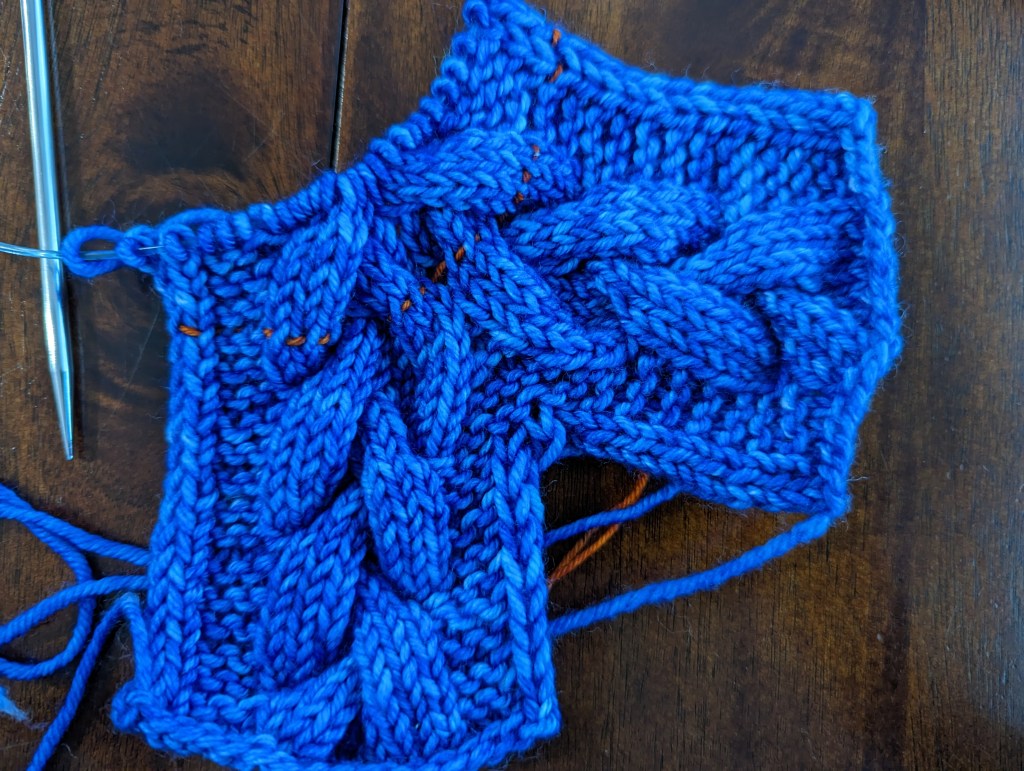
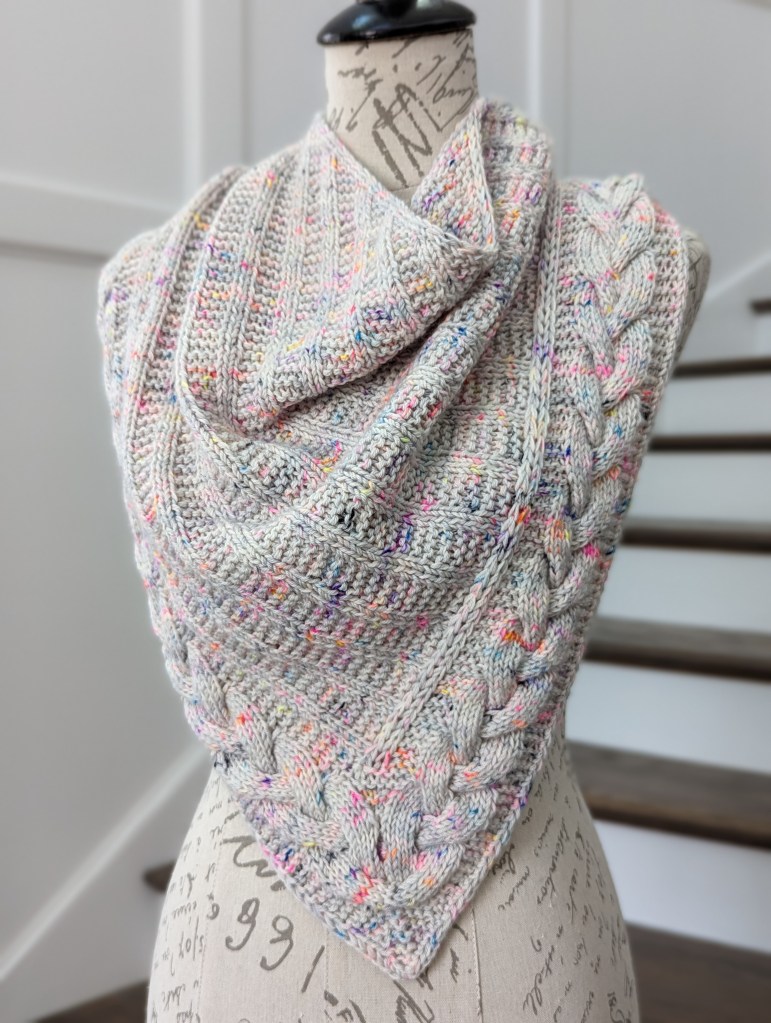
Chirality Socks

I am so excited to introduce my newest design, Chirality Socks! This pattern has been one of my favorites to design and is so fun to knit up. The pattern is available now on Ravelry.

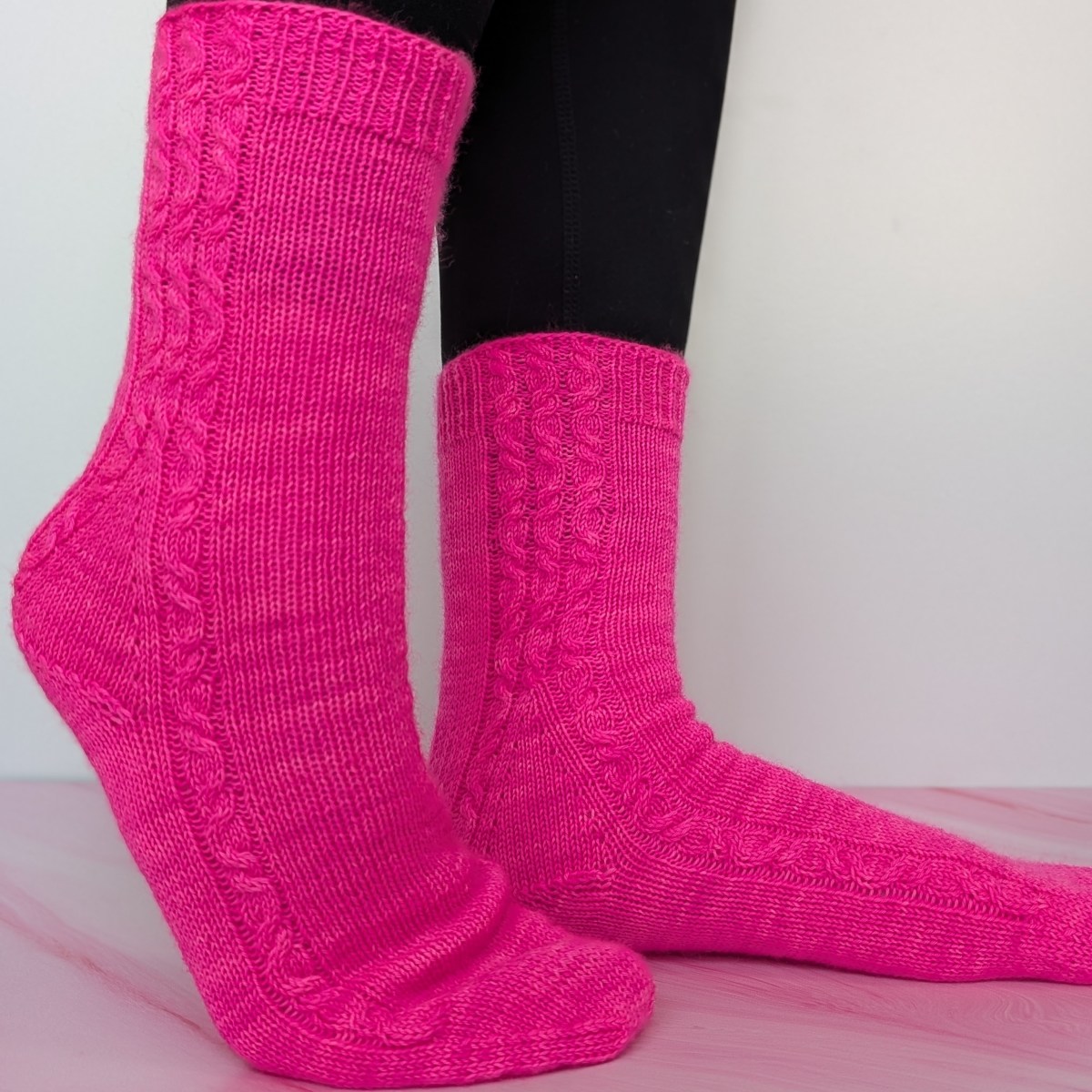
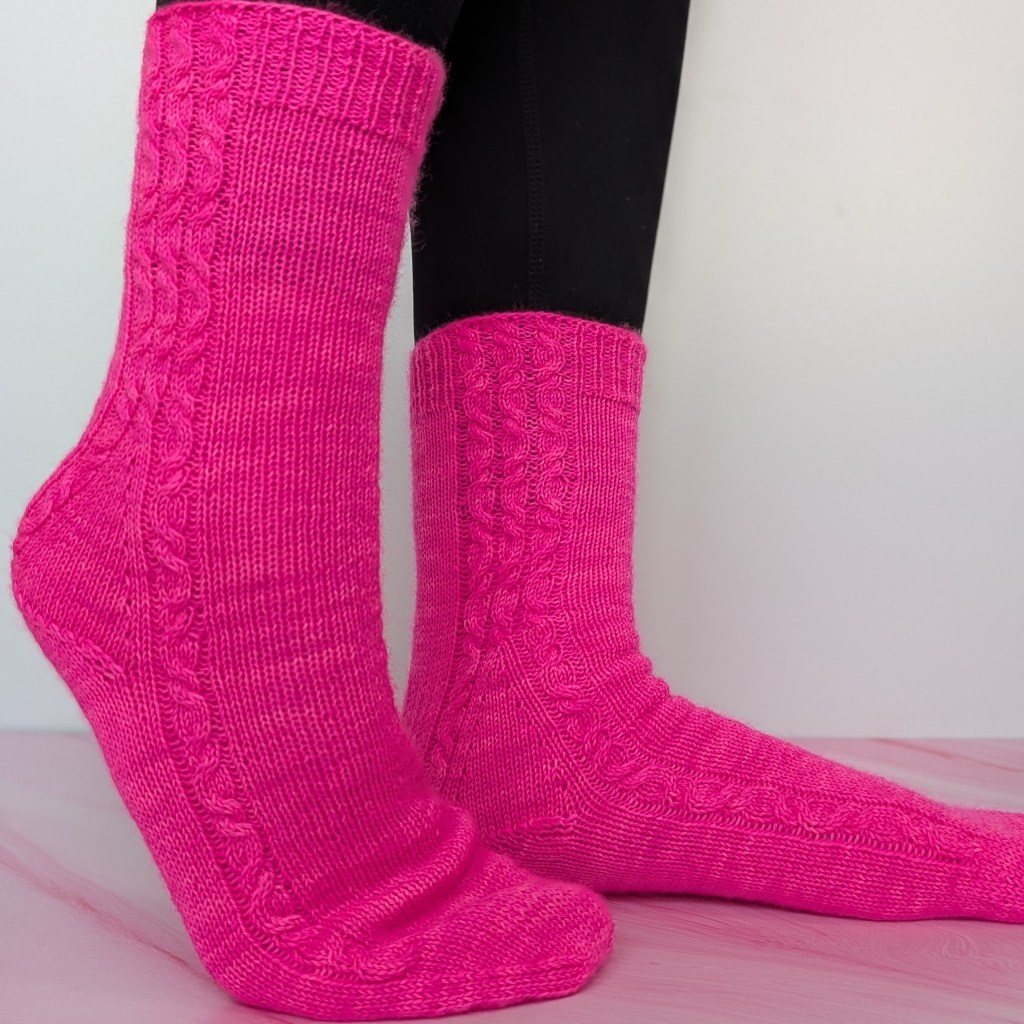
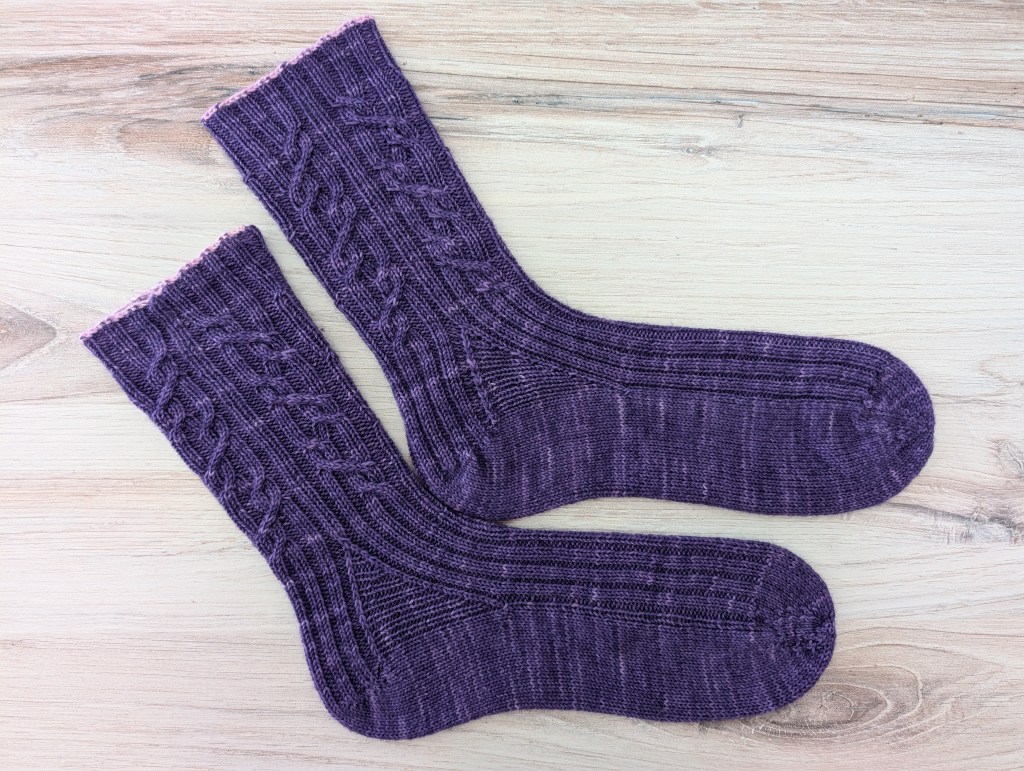
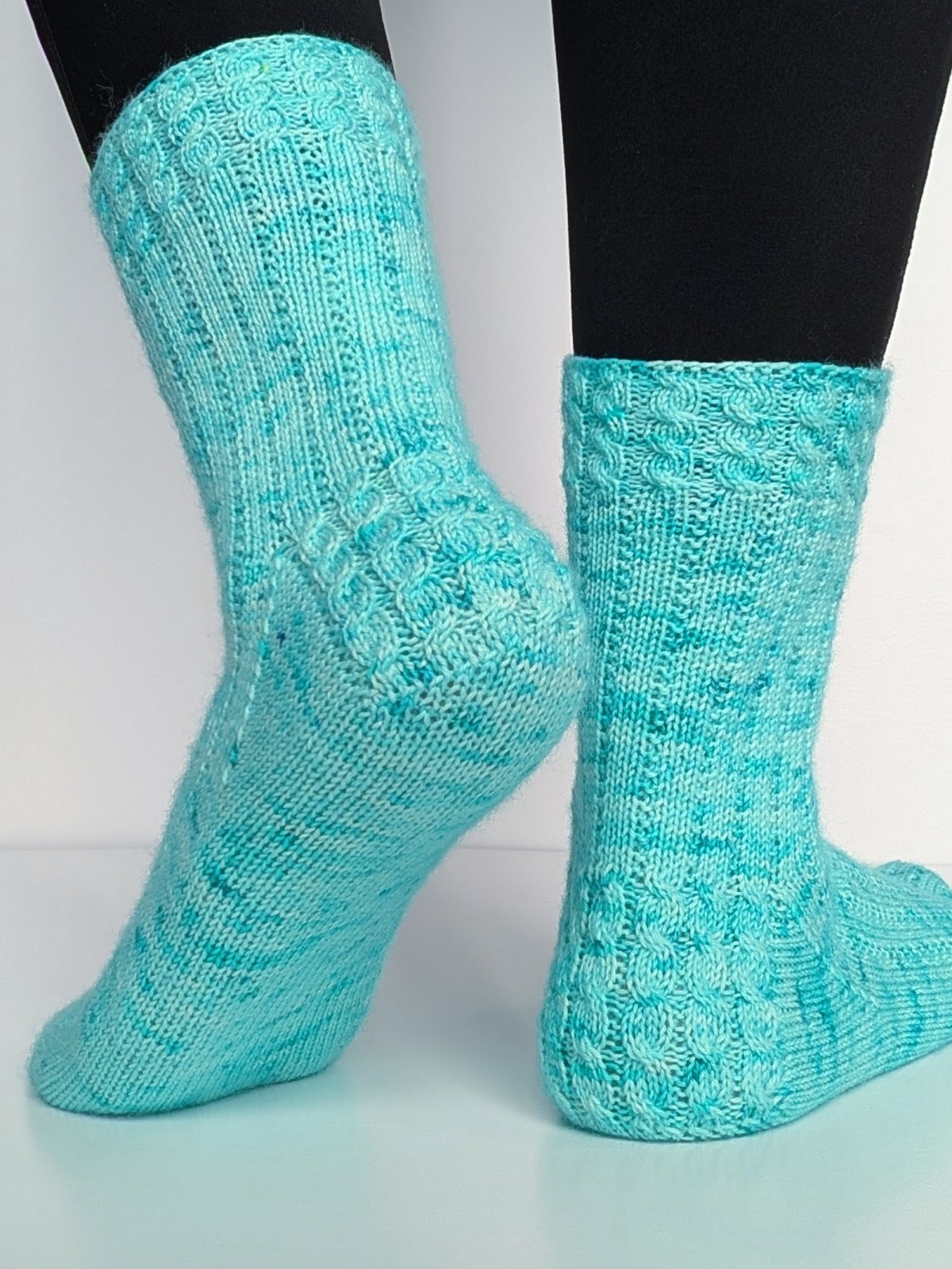
The Chirality Socks feature a lovely cabled rib pattern that travels from the cuff to the toe and even onto the heel! The cables on each sock twist in opposite directions, making them “chiral,” or non-superimposable mirror images. I loved adding all of these little details onto the socks and figuring out the best way to arrange them. I’ve always wanted a pair of socks that were cabled all over, and the Chirality Socks are the closest I’ve gotten to that so far. I love how these dainty 1-over-3 cables add a beautiful texture to the socks.

For the Chirality Socks, I chose this lovely, very lightly speckled yellow from Teal Torch Knits, called Dose of Sunshine. I used her TTK Sock base, which is probably one of my favorite sock yarns to design with — I feel like Christina’s colorways just “get me” with their brightness, joy, and neon amazingness, so I keep finding myself on her shop again and again to order more skeins.

Designing Challenges

When I’m designing, I like to work in increments of eight so that I can always include my standard sizing: 48 {56, 64, 72, 80} stitches (because I never want anyone to feel left out). The good news is that I can fit a lot of design into eight stitches, but sometimes I end up with something that I want to split, and for my 56- and 72-stitch size socks, this can be extra challenging since they won’t have a full eight-stitch repeat on the front and back of the sock.

I consider it a personal challenge to include all of the elements of the designs in all of the sizes and to make them as symmetric and centered as possible. For the Chirality Socks, this means that I needed to set up the 56- and 72-stitch sizes to have one more cable on the front of the leg than they do on the back of the leg. That way, they get maximum cabling and no interruptions to the cabled rib motif. It took a while for me to solve this problem, but in the end, I think the socks turned out beautifully.

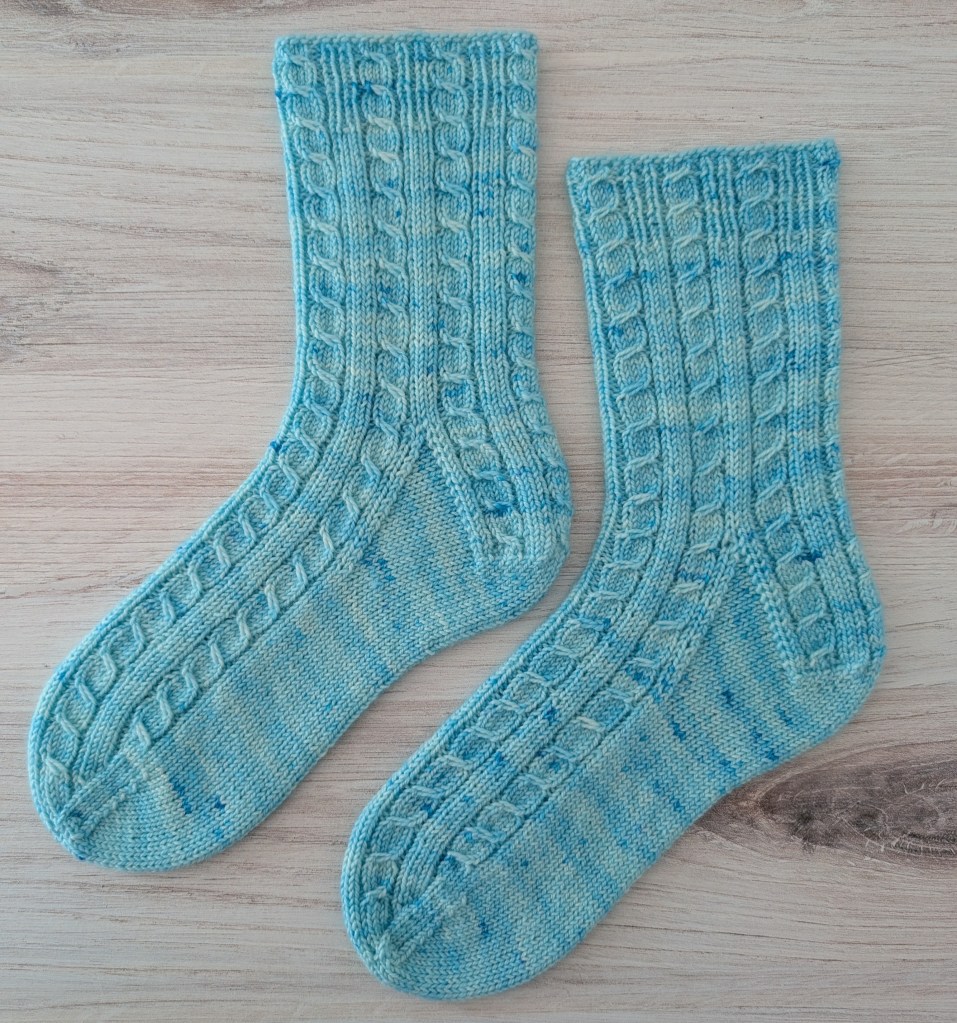
As a result, the 56- and 72-stitch sizes have a slightly different heel flap, where the pickups will proceed as they normally would in one of my slipped-stitch heel flaps. Here is a pair that I made for my daughter in this lovely blue from Adella of Lolabean Yarn Co. This pair was made using her Bean Sprout base in the Chevron Chalet colorway, which was an Eat.Sleep.Knit exclusive from a few years ago.
Picking Up Stitches

The even sizes of the sock (48 sts, 64 sts, and 80 sts) have the cables going all the way to the edge of the heel flap so that everything stays centered. This ended up being slightly different to pick up stitches. I always like to pick up the strand between the slipped-stitch edge and the stitch right next to it. I find that this makes a lovely, clean pick-up edge on both the inside and the outside of the sock, and it avoids gaps or bonus spaces in the pickup.

On a regular slipped-stitch heel flap, the neighboring stitch is always a knit stitch (when viewed from the right side of the sock), but in this case, the neighboring stitch is a purl stitch.

When the pattern was in testing, we realized that for the 48 sts, 64 sts, and 80 sts sizes, unless you pick up your stitches similarly to how I do them, you might end up with a slightly different look at the edge of the heel flap. I recorded a video tutorial to show you how to get this lovely edge that looks great from the outside and the inside of the sock. You can find the video here:

This technique can be applied to any heel flap where there is a slipped stitch edge with a purl stitch right next to it. The technique will also work for when there is a neighboring knit stitch, but it will look slightly different. Are you interested in seeing how I pick up stitches on my regular heel flaps? Let me know!

Appropriate Dye Styles

This design will look fantastic in any fingering weight wool or wool blend yarn in solid, tonal, lightly speckled, heathered, or low-contrast colorways. I would consider both of the colorways above to be *very* lightly speckled, but how does the sock look with some more speckles?!
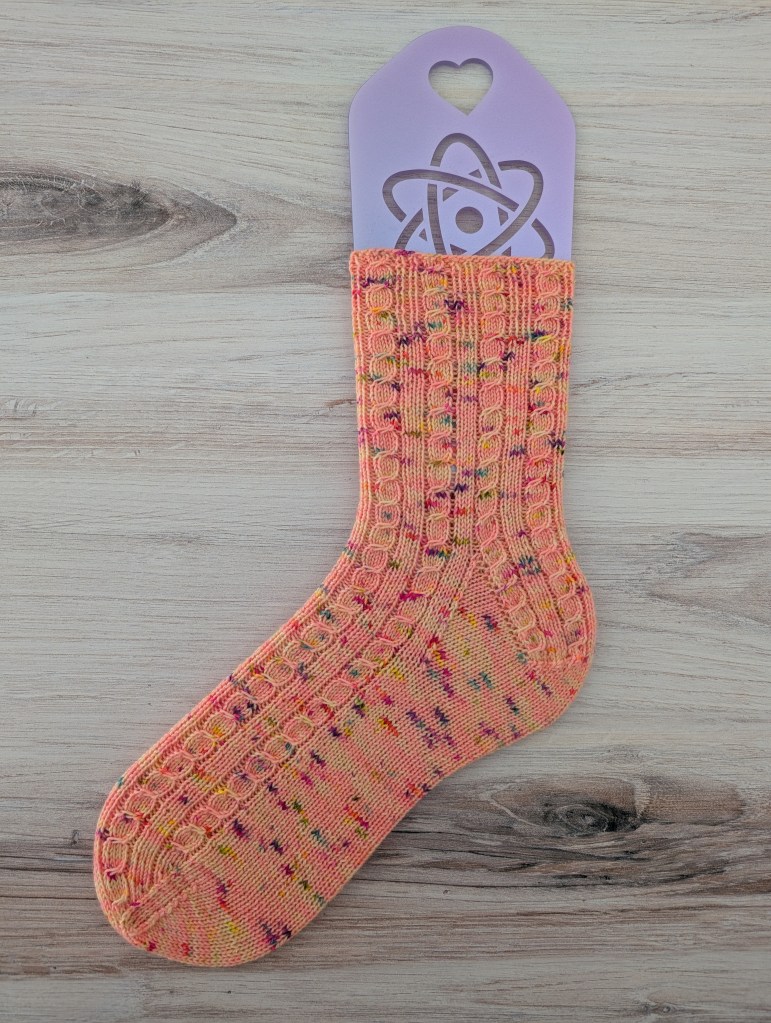
Personally, I think it looks fantastic! This gorgeous peach colorway is from The Lemonade Shop, and Heather is so talented at getting these teeny tiny individual rainbow speckles onto her skeins. Please forgive that there’s only one sock so far — the other one was the one I used for filming, and it just needs to be finished up, and then I’ll be wearing them all the time!

My lovely test knitters also knit up their socks in a variety of colorways. You can check out this page on Ravelry to see some of their gorgeous photos.

Thanks & Coupon Code

Thank you so much for being here and for reading through my design ramblings. Subscribers can use the code TECHNICOLORMOM to get 50% off of the pattern now through Friday, October 24, 2025. I can’t wait to see your beautiful Chirality Socks!

On the knitting front, I have accumulated an alarming number of single socks (*cough* more than ten *cough*), but I am working away on them and having so much fun. Are you hoping to see any design elements or techniques used in a future sock pattern? Let me know in the comments!

Wave Function Socks

Hello, crafty friends!

(Re-)Introduction

We have a lot of new subscribers here on the website, so I wanted to take a moment to welcome everyone who is just joining us. (Seriously, every time I get a notification that I have a new subscriber, I have a little \*squee\*.) I’m Amanda, and I am an aspiring professional knitter and knitwear designer in my free time. In my not free time, I am lucky to be a stay at home mom for my two children. You’ll see that a lot of my patterns are science-inspired. I earned a Ph.D. in chemistry (many) years ago and spent (many) years teaching college students how to safely work in the laboratory and how to draw organic reaction mechanisms. Now I get to apply all of my skills to crafting and keeping things semi-organized for my kiddos and amazingly supportive husband, @Technicool_Dad. I am lucky to get to volunteer at the kids’ school and to take them to all of the soccer practices and art clubs, and of course, car line pick up is one of my favorite activities — getting to see their smiling faces first thing after school is just the best feeling.

Pattern Inspiration

Today I am so excited to share that my newest pattern, the Wave Function Socks, has finally been published! When I took physical chemistry in college, quantum mechanics was one of my favorite topics. It was all math and functions and complex formulas, and my brain just loves a good problem. The wave function of a particle describes a few things, including the probability of a particle’s location being in a specific place. My friends and I liked to make jokes about how parts of our wave functions were vacationing on the beach — admittedly, this was a very low probability, but we thought we were funny and clever.

The Wave Function Socks presented a few good design challenges that I was keen to tackle. The first problem I tackled was determining the perfect formula for cable spacing so that the waves would be visible both on a sock blocker and when worn. After many swatches, I think I ended up with the perfect wave cables! For these socks, I really wanted to have the cable panels centered on the sides of the sock instead of on the instep, and for the cables to transition neatly to the foot and the heel. To accomplish this, I created a modified Strong Heel. This variation features slip-stitch reinforcement where your socks rub against the back of your shoe, and the symmetric increases on the side allow the cables to gracefully flare out over the ankle. Best of all, we have a look and fit similar to that of a heel flap and gusset, but with no picking up of stitches.

The Wave Function Socks feature an easily memorized pattern that will allow you to take them on the go or allow part of your mind to wander off on its own wave function beach vacation. Carefully placed increases and decreases mean that you don’t have to debate which size to knit — just cast on for your normal size!

The pattern will play nicely with any fingering weight merino/merino nylon blend yarn in solid, tonal, lightly speckled, gradient, or low-contrast colorways. The pattern has been tech edited and test knit and is all ready for you to cast on!

Coupon Code!

Thank you so much for subscribing to my newsletter! Please enjoy 50% off of the Wave Function Socks pattern now through August 8th with the code TECHNICOLORMOM.

New Free Pattern: Watering the Trees Beanie!

I’m so excited to share my newest pattern, the Watering the Trees Beanie! This pattern was designed intentionally for gift and charity knitting and is my gift to you. You can snag your copy of the Watering the Trees Beanie Pattern here.

For the past couple of years, I have endeavored to knit hats for my growing number of nieces and nephews in lieu of toys. In 2024, I knit a dozen hats in December. Although I failed to capture a photo of all of them together, I did share a reel on Instagram. Not all of the designs that I used have been published yet, but I did manage to get one of them written up, tech edited, test knit, and finally published!

Pattern Inspiration

The Watering the Trees Beanie is the hat version of my Watering the Trees Socks pattern that I designed a couple of years ago. The idea came about after my then-six-year-old and two-year-old decided to “water” our backyard trees. The event mostly involved the two of them running around and spraying each other with the garden hose, but they had fun, and the two maple trees in our backyard did manage to get a bit of water. When the light caught the droplets of water just right, a little rainbow added joy to our backyard fun.

The design features two mirrored cables to represent our two maple trees, and the textured ribbing makes me think of the streams of water from the garden hose. The pattern features my signature use of increases and decreases to make the cables pop without bunching or gathering the fabric beyond the cables.

Sizing

The Watering the Trees Beanie pattern includes sizes for the whole family, including baby, toddler, child, adult s/m, adult l, and adult xl sizes. It is designed to fit head circumferences from 14″ (36 cm) to 26″ (66 cm) comfortably. I prefer a generous fit in my hats, so I size my patterns with a looser fit in mind; you can size down for a snugger fit.

I have a 23″ circumference head and prefer the adult l size. You can see it here in purple.

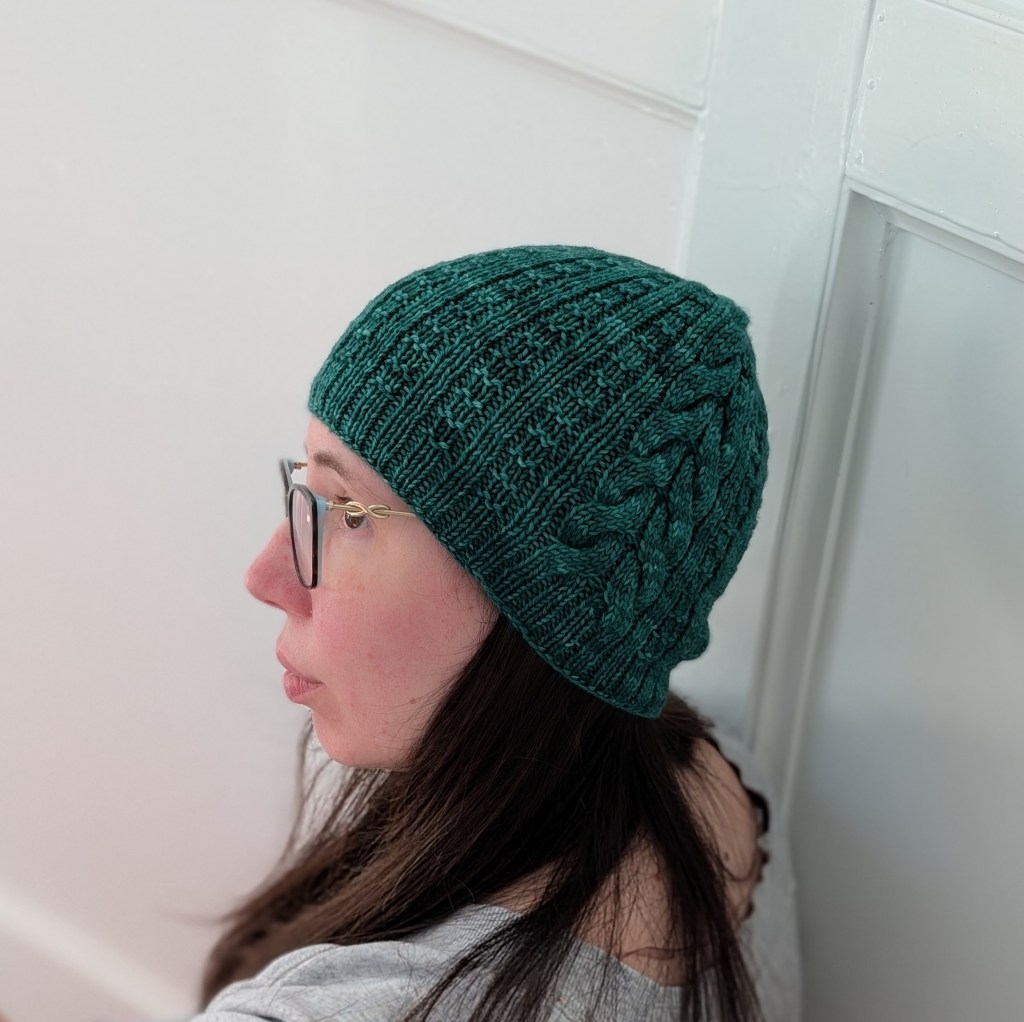
I suspect that the most commonly knit size will end up being the adult s/m size, which I am modeling here in green.

Matching Socks

Should you decide that you need some matching cozy socks, check out my Watering the Trees Socks pattern. These socks are cozy and cabled, and my use of increases and decreases for the cables makes choosing a sock size easy – just pick the cast on number closest to the one you use for your favorite vanilla socks. You’ll want to stick with a similar favorite yarn and needle size for socks.

Gift Knitting

This hat knits up rather quickly using DK weight yarn, and I love it for gifts for anyone. I hope you’ll join me in making a few of these hats for yourself, your friends and family, and for donations to individuals and organizations who may need some extra love in the coming seasons.

Do you have any preferred organizations that you knit for? Let me know here! I’m planning to send a few pieces up to Knit the Rainbow and already have a couple saved away for them.

Sock Madness 2025: Qualifying and Round 1

Did you know there are such things as sock knitting competitions? There are! This year, I joined the Sock Madness 19 group over on Ravelry and registered to participate. This is the 19th year that the moderators have hosted the Sock Madness competition. The idea is that there is a qualifying round followed by seven rounds of competition, with a smaller number of knitters progressing to each subsequent round.

The competition is well known in the sock knitting community for its “madness”: crazy socks, unique constructions, and lots of challenges and new techniques. The idea is to try out something new while learning and knitting along in a friendly competition. The competition is free to participants, and we receive a materials list and some very obscure hints about the socks, but we don’t know what the socks will look like or which techniques will be used until each round begins. There were over 1800 participants in this year’s competition.

After participants let the moderators know that they’ve completed the socks, the moderators check the participant’s project page on Ravelry to “grade” the socks and make sure that the knitter followed the directions closely and met the minimum requirements.

Qualifying Round

The first pattern that we knit for the competition was Conjoined Sock Twins, a pattern by new designer Katherine Richmond. This pattern was unique because we cast-on to start at one toe, knit up through the foot, heel, and leg, then continued knitting the leg of the second sock down through the heel, foot, and toe. We all ended up with some crazy looking sock snakes before we separated the socks out and did a stretch bind-off in a contrasting color.

After separation, these socks were just like any other pair of socks, and they ended up fitting me really well! This was definitely fun, and the bonus was that there was no second sock syndrome for it. This was also the first time that I made a ribbed gusset for socks, and I enjoyed how stretchy it is. The cables in this pattern were really fun to knit.

Qualifier Sock Stats

Pattern: Conjoined Sock Twins by Katherine Richmond.
Yarn: Birch Hollow Fibers Sylvia Sock in Netherwing with Hedgehog Fibres Sock in Hush for the bind-offs.
Cast-On (started): February 16, 2025
Bind-Off (finished): February 23, 2025
Yardage: 360 yards
Size: 64 sts
Needle: 2.5 mm (US 1.5)

After the qualifying round was over, participants were sorted onto teams based on how quickly they completed this pair of socks and their answers to a survey about their normal knitting habits. There were 26 teams, sorted from Team A (on the more relaxed end) to Team Z (on the speedy end). I was sorted into Team Q for this year. This ended up being the perfect spot for me! We started with 52 members on each team.

Round 1

Participants don’t know what day or time the patterns for each round will be released. It’s a surprise! The times are distributed throughout the rounds to make the competition fair – there are participants from all over the world. This pattern was released at 1:13 am in my time zone. The first round pattern was the Day & Night Socks by Alena Malevitch. These socks were really interesting to knit. I made the 70 sts size hoping that the socks would be for me, but alas, they were too tight, so they went to my daughter. She is quite happy with them. This was my first time doing mosaic colorwork and intarsia for socks, and it ended up with a really neat effect. The socks are mirrored, and it took me about half of the first leg to memorize the pattern.

Round 1 Sock Stats

Pattern: Day & Night Socks by Alena Malevitch
Yarn: Emma’s Yarn Beautifully Basic in Poppin and Love Drunk
Cast-On (started): March 4, 2025
Bind-Off (finished): March 10, 2025
Yardage: 289 yards
Size: 70 sts
Needle: 2.25 mm (US 1)

This was an elimination type format, so knitters had two weeks to complete each pair of socks or until the first 45 knitters on their team completed the socks. I’m pretty impressed that I was able to finish each of these pairs of socks in less than a week! Luckily, I finished in time to secure a spot in Round 2. I’ll post all about that next time!

Alexander Socks!

Y’all! I designed another pair of socks! In 2019 years ago, I reached out on Ravelry to recruit test knitters for my third sock pattern, the Fireside Cable Socks. One of my volunteers, Jordan, knit a lovely pair of socks as she was testing out the pattern before publication. Fast forward to 2022, when I was able to regularly go to my local knitting group for Knit Night. I became fast friends with Jordan, who shares my love of pink, hand-dyed yarn, and all things cables. A long while later, we realized that these two Jordans were the same person! How small is the world that someone I interacted with online three years before ended up being at my Knit Night?!

Jordan is on the receiving end of a lot of my design-related brainstorming, and she is enthusiastic and encouraging as she reads and responds to all of my text messages. I’m so thankful that we had the chance to meet in person! We have spent a lot of time talking about socks and what would be our “perfect” sock design. Jordan really loves when patterns continue onto heel flaps, and we both really love cables.

So, I promised her a design with a fancy heel flap. And here we are! The Alexander Socks, named for my friend Jordan, are for those of us Hamilton fans who will never be satisfied with vanilla socks and want to elevate our socks without a huge commitment to fixing missed cable crosses or having to focus, focus, focus. When incorporating these cables, I used what has become my signature increases and decreases at the starts and ends of the cables so that you don’t have to think too hard about which size to make — just use your vanilla stitch count, and you are good to go. I used Teal Torch Knits TTK Sock in the colorway Tall Drink of Water for my sample, and I love how these light speckles look with the cables.

The Alexander Socks are knit cuff down, beginning with a German Twisted Cast-On and a beautiful cabled cuff. The leg of the sock features a relaxing 3×1 broken rib that continues down the foot of the sock. A cabled heel flap levels up the socks, and a traditional gusset makes for a great overall fit. The broken rib texture flows into the rounded toe for a polished look with a comfortable fit. Kitchener stitch is used to finish off the sock.

I’ve now knit three pairs of these socks — two for myself and a tiny pair for my 4-year old. The great news is that this pattern includes five cast-on sizes: 48 sts, 56 sts, 64 sts, 72 sts, and 80 sts. The 48 sts size is great for little kids with fingering weight yarn, or if you knit them with DK weight yarn, you’ll get a super cozy pair of adult socks. I use the 56 sts size for my 8 year old, and I knit the 64 sts size for myself. I usually use 72 sts for my husband or dad, and the 80 sts size is great for anyone who struggles with foot swelling or needs a looser fit.

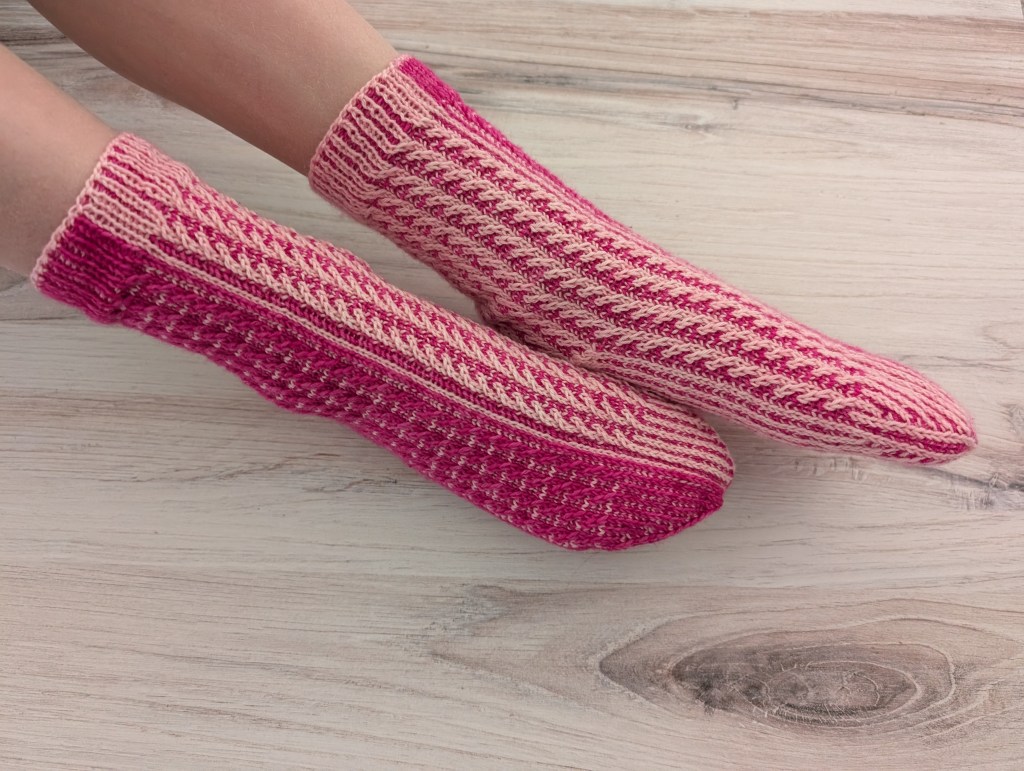
I knit these pink socks using Leading Men Fiber Arts Show Stopper in the Pink Lemonade colorway. How amazing is that tonal?! I already have another pair of these on the go for my daughter, and I’ve got several skeins of yarn that would look amazing with these cables. What colorways do you think will look fantastic in these socks? I think this pattern will play nicely with any fingering weight merino/merino nylon blend yarn in solid, tonal, lightly speckled, or low-contrast colorways. I’m thinking Lolabean Yarn Co’s The City So Nice, They Named It Twice colorway would look amazing in this design — I used that colorway for my Concentration Shawl design a couple of years ago.

Are there any design features that you would love to see in a pair of socks? I’m really enjoying the fancy cuffs and heel flaps and of course cables!

Dragon Fairy Socks

I think it would be accurate to state that I am obsessed with my latest sock pattern. Last week, I published the Dragon Fairy Socks pattern, and I love, love, love knitting these socks. This design features a textured panel on the front of the sock, and the back of the sock is stockinette. When I say these fly off the needles, I am not kidding. I gave a sneak peak of the sock a few weeks ago when I shared the socks I made for my grandmother. I gifted them to my grandmother for her birthday, and she loved them!

The difficulty rating for the Dragon Fairy Socks pattern is EASY. This project is worked in the round from the cuff down and includes an easy textured stitch and decreases. Kitchener stitch is used to finish off the toe.

The pattern has been tech edited and test knit.

DESIGN INSPIRATION

On the way home from school one winter afternoon, as I was finishing up the second sock for this sample, my daughter was arguing that she didn’t feel cold outside because she is a “Fire Fairy.” My 3-yo piped up and declared that he is a “Dragon Fairy,” and I thought the conversation was just the cutest thing. I was struck by how the texture on the front of these socks resembles dragon scales and how the knitted bars highlight individual colors in the fabric like the sun glinting off of iridescent fairy wings. Thus, I decided to call these socks the “Dragon Fairy Socks.” The texture on these socks makes the pattern ideal for any yarn dyeing style, from solid to variegated and anything in between.

RECOMMENDED YARN

This pattern will play nicely with any fingering weight merino/merino nylon blend yarn in solid, tonal, speckled, or variegated colorways.

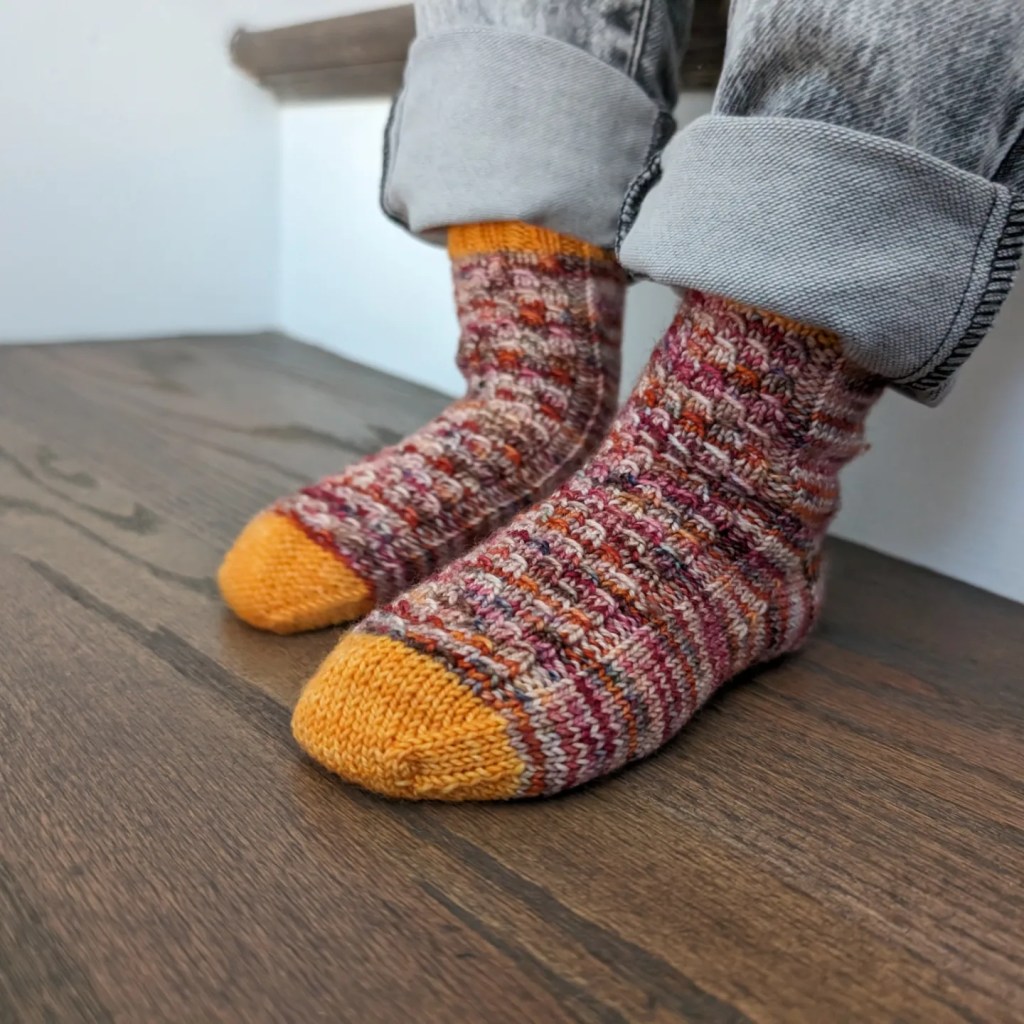
I used Sock by Teal Torch Knits, a 75% superwash merino wool/25% nylon, 463 yds (423 m) per 3.5 oz (100 g) base. I used Christina’s Cake by the Ocean colorway for my blue/green sample. I love how the texture stitch shows off the variations in this color, and I am loving seeing this texture in yarns that I collected long ago but wasn’t quite sure what to do with.

Below you can see the pattern in Sweet Sock by Twisted Ambitions; I used Russ’s Sweet Like Candy colorway for these beauties, and I love how they turned out. I started these on February 5, 2024 and finished them on February 12, 2024. I always knit the 64 sts size for myself.

It was a little tricky to get the lighting correct for these socks, but the color is probably closest to the cooler photo on the right.

GIFT KNITTING

My children are so incredibly knit worthy, and for Valentine’s Day this year, I made them each a pair of Dragon Fairy Socks using Sequoia Sock by Treehouse Knits. I collected Lauren’s Land of the Living colorway a couple of years ago. I love how well this design shows off the intricacies of this colorway.

This sock set came with two minis, and I used them to add a pop of color at the cuff and a contrast cuff and toe. I used the 56 sts size for my 7 year old’s pair, which I started on January 17, 2024 and finished on January 22, 2024. For my 3.5 year old child, I used the 48 sts size and started them on January 22, 2024 and finished on January 25, 2024.

I have since started three additional pairs of these socks — two for my 7 year old and one for my husband, and I can’t wait to share them when they are finished.

Do you have any collected yarn that has been hiding away, unsure of what it wants to become? What yarn would you use for these socks?

Pause Time Socks

I am so excited to share that the Pause Time Socks pattern is officially out in the world! This pattern is available on Ravelry, and the code PAUSE20 will get you 20% off now until Tuesday, February 6, 2024.

The Pause Time Socks are knit cuff-down, beginning with a German Twisted Cast-On and 2×2 rib. The leg and foot of the sock feature a beautiful trio of short and long cables on the front of the sock and stockinette on the back. A traditional heel flap and gusset make for a great overall fit, and a rounded toe and Kitchener stitch finish off the sock.

The difficulty rating for the Pause Time Socks pattern is INTERMEDIATE. This project is worked in the round from the cuff down and includes cables, slipped stitches, increases, and decreases. Kitchener stitch is used to finish off the toe.

The pattern has been tech edited and test knit.

Pause Time Socks in Neon Melon

DESIGN INSPIRATION

It seems as though the older I get, the faster time goes, and sometimes I wish I had the ability to pause time. My two children seem to change and grow as quickly as the smaller cables on the Pause Time Socks. As I typed up this pattern, my three-year-old sat in my lap, pretending to type and control my finger movements. He won’t be small enough to sit in my lap for long, but I will enjoy the moment for now. The larger central cable takes the shape of an hourglass with longer stretches of stockinette between the cables, reminding us to pause and breathe in the beautiful moments around us.

RECOMMENDED YARN

This pattern will play nicely with any fingering weight merino/merino nylon blend yarn in solid, tonal, or lightly speckled colorways.

I used Sock by Teal Torch Knits, a 75% superwash merino wool/25% nylon, 463 yds (423 m) per 3.5 oz (100 g) base, in the Neon Melon colorway for my sample. I love how these cables pop in this color, and I cannot wait to get these cables onto some more accessories.

GIFT KNITTING

One of my goals for this year is to knit using stash yarn, and another is to knit gift socks for my extended family members. My husband, dad, mom, Grandma, MawMaw (maternal grandmother), and mother-in-law have all been enthusiastic supporters of my knitting endeavors, and this year I want to treat them to some handmade socks.

I wrote about the Dragon Fairy Socks that I gifted my Grandma a few weeks ago, and I just finished up a pair of Pause Time Socks for my MawMaw. She wears a size 6 shoe, so I was able to finish these up in just a few days. I love how these cables look in this gorgeous tonal yarn.

Pause Time Socks in Sangria

For these beauties, I used The Lemonade Shop House Sock in Sangria, which I purchased in September 2020. My MawMaw loves bold, saturated colors, so I thought this colorway would be perfect for her. I started these socks on January 26, 2024, and I finished them on February 2, 2024. You can find more info about this pair, including when I started the toe of the sock, on my project page on Ravelry. I’ve already started working on the sunburst granny squares to use up the leftover yarn.

Do you have a beautiful tonal or solid skein that would look amazing in these cables languishing in your stash? Maybe it’s time to cast on! Have you knit cables before? If not, what is holding you back? I’d love to ease any fears you might have about cable knitting.

Design Process Spotlight: Dilution Cowl

I was participating in a general cowl knitalong (KAL) with my local yarn store, Eat.Sleep.Knit, in early 2023 when the idea for the Dilution Cowl came to me. I was originally choosing colors for a different cowl project by one of my favorite designers – one where you hold a strand of DK weight yarn with a strand of fingering weight yarn, but alternate out the fingering weight yarn to create a marled fade. I made several swatches and could never settle on a good fade using only stash yarn. Eventually, I realized that I needed to choose something different because I felt like I was forcing the colors.

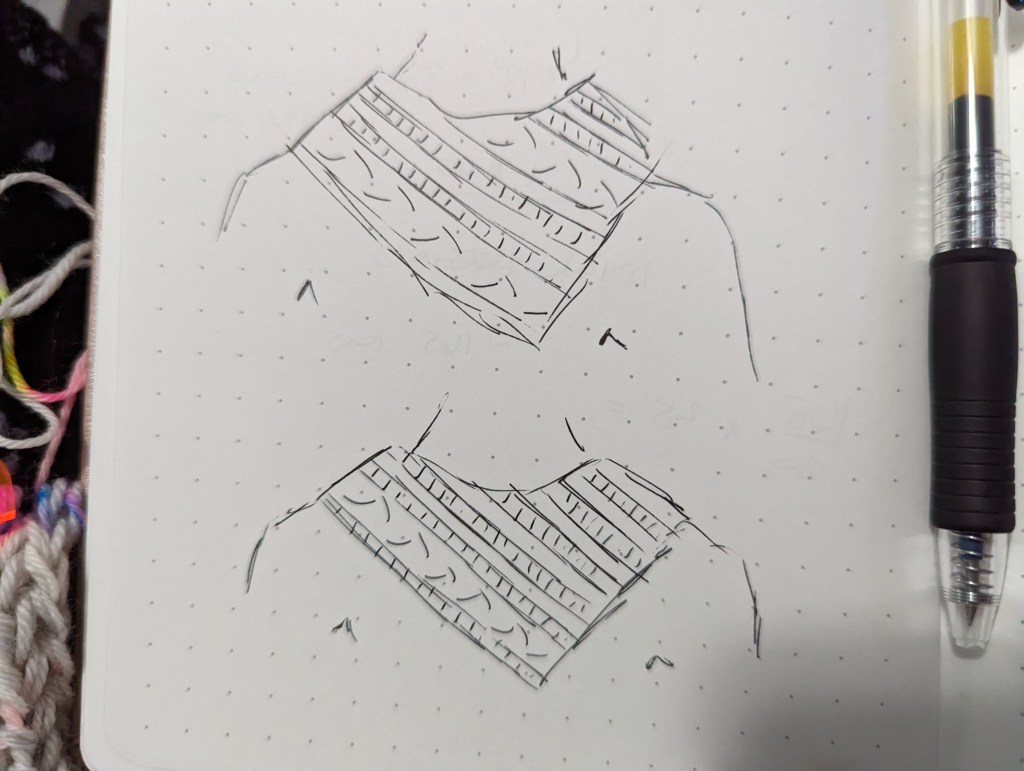
I loved how the DK weight yarn diluted out the speckles of the fingering weight yarn, and after I found a pair of yarns from my stash that I loved together, I knew I had to make something really special with it and started sketching. An asymmetric shawl is my favorite shape to knit for a shawl, and when this yarn spoke to me, I knew it wanted to be a cowl that had that same asymmetric shape. I wanted it to have a cable that was featured on the front and to have an interesting but easy texture for the drapey part of the cowl.

The earliest sketches of this cowl just had the cable along one side, and I just started knitting. This literally flew off my needles and was only slowed down by me stopping to take photos to share with a friend and admire my work. Do you do that? Stop to gaze lovingly at your knitting or crafting? If not, you should totally try it! Be impressed with yourself! You are creating something amazing!

Now, as I approached the length that I wanted the neckline to be, I started to think about how I wanted to finish off the live edge. I considered a simple i-cord bind off, and while I think that would have looked really nice, I decided to try something crazy and attempt an applied edging, where you knit an edging perpendicular to the body of the fabric. The idea was that I’d try to make the cables meet at the corner, but if I couldn’t make it work out, I’d just overlap them and call it a day. Usually I don’t put a lot of pressure on myself to just finish and prefer to figure it out, but I was on a relatively short deadline for the cowl KAL that I wanted to submit the project for. After several hours on the floor with a notebook, a calculator, and a measuring tape (which my children call “measuring snakes”), I ended up with a tentative plan.

I did not get the corner right on the first try. I got down to where I was ready to start intertwining the cables and started taking very meticulous notes. After the first attempt failed, I realized I needed to switch to a swatch so that I wouldn’t wear out the yarn with multiple frogging and reknitting attempts. I am a problem solver, though, and I just knew that I could solve this problem if I stuck with it. It took me about three tries to get it right, and let me tell you, I was just over the moon with pride at how clever I was when I did.

Once I had a good idea of how the corner was going to go, I switched back to the main project, finished out the corner, blocked the fabric, and seamed up the back, and there it was, the Dilution Cowl! I just love how this project turned out.

The last time I had published a pattern before the Dilution Cowl was in late 2019, so I was a little nervous about putting this design out into the world, but I’m so glad I did! Once I got back into the swing of things, I managed to publish seven patterns in 2023. Some of my design processes have been much more intentional than how the Dilution Cowl design process went, and some of them have just been the kind where I start knitting and see where it takes me. I can’t say that I have a strong preference for one over the other, but the laissez faire type definitely seems magical.

If you love the texture and cables in the Dilution Cowl, check out the Concentration Shawl, the Solution Socks, and the Solvation Hat. I’m also in the process on working on a baby blanket version where the cables go all the way around the perimeter of the blanket, and let me tell you that figuring out how to do the corners and cables on that one was even more satisfying than finishing up the corner on the Dilution Cowl. (That one took about seven tries, and I ended up with a whole pile of swatches.)

What do you think? Do you ever start knitting a project with a yarn and realize that the yarn wants to be something else? In a way, I think this is very similar to an author whose characters start taking them in a different direction than the author originally intended. The yarn is a character, and sometimes it needs its own adventure!

Aspiring Professional Knitter

Concentration Shawl

A few years ago, I taught a first year college seminar class to help introduce students majoring in chemistry and biochemistry to some essential skills for succeeding in college. One of our major units focused on career exploration, and I tasked the students with thinking about three career paths:

  • The career path they were on, if everything went according to plan.
  • An alternative career path, if things did not go according to plan.
  • Their path if they were unbound from societal and family pressures.

The first two paths were pretty typical for students, with many students focused on healthcare, pharmaceuticals, and chemical industry. The third path was always the most interesting, with students choosing anything from “food blogger” to “freelance artist” to “baker.” This was how I really got to know my students and what their interests were, and it was so cool to learn all of their unbound plans.

Of course, I always shared how I would have answered those questions. The career path that I was on in college was to be a college chemistry professor and involved earning not only a bachelor’s degree but also a doctorate. Following graduation with my Ph.D. in organic chemistry, I enjoyed working in that career path for almost a decade. My alternative career path, as I answered when I was starting college, was to go into banking because I loved math. Now, of course, my answer would be to work at my LYS (local yarn store).

My “choose anything” career path is to be a professional knitter, so I always say that I am an “aspiring professional knitter,” even back when I was introducing myself to my organic chemistry students.

These days, I am a very lucky stay-at-home-mom to a 7-year-old and a 3-year-old and wife to the incredibly talented TechnicoolDad, and I couldn’t be happier. I am still an “aspiring professional knitter,” and I spend just about every free moment knitting (or reading, sometimes both at the same time!). The car line to pick up my daughter from school is one of my favorite places to knit, where I’ve got about half an hour of quiet time when I can really focus on my projects. My spouse makes it a priority to be home when possible so that I can attend my local knit night and spend THREE WHOLE HOURS knitting and chatting with my friends, making me feel spoiled and refreshed.

Sometimes, inspiration strikes, and I design my own patterns. I love this creative outlet, and in 2023, I managed to design, knit, write, and publish SEVEN new patterns, including four pairs of socks, a cowl, a shawl, and a hat. I have a few designs lingering from last year and on the needles that I hope to finish up soon and get published as well, but my family is my top priority and I am a “mood knitter,” so my design process can be somewhat sporadic. All of my paid designs are professionally tech edited to ensure maximum clarity and minimum confusion, and each pattern is tested by generous fellow knitters to catch anything that my editor and I have missed.

I’m planning a series of posts to discuss the origin of each of the ideas for these designs. The design featured at the top of this post is my Concentration Shawl (yes, it’s a chemistry thing) pattern that I absolutely adored knitting and designing, so look for a post about it soon!