
Subscribe to continue reading
Subscribe to get access to the rest of this post and other subscriber-only content.

Subscribe to get access to the rest of this post and other subscriber-only content.
Hello, crafty friends!
We have a lot of new subscribers here on the website, so I wanted to take a moment to welcome everyone who is just joining us. (Seriously, every time I get a notification that I have a new subscriber, I have a little \*squee\*.) I’m Amanda, and I am an aspiring professional knitter and knitwear designer in my free time. In my not free time, I am lucky to be a stay at home mom for my two children. You’ll see that a lot of my patterns are science-inspired. I earned a Ph.D. in chemistry (many) years ago and spent (many) years teaching college students how to safely work in the laboratory and how to draw organic reaction mechanisms. Now I get to apply all of my skills to crafting and keeping things semi-organized for my kiddos and amazingly supportive husband, @Technicool_Dad. I am lucky to get to volunteer at the kids’ school and to take them to all of the soccer practices and art clubs, and of course, car line pick up is one of my favorite activities — getting to see their smiling faces first thing after school is just the best feeling.
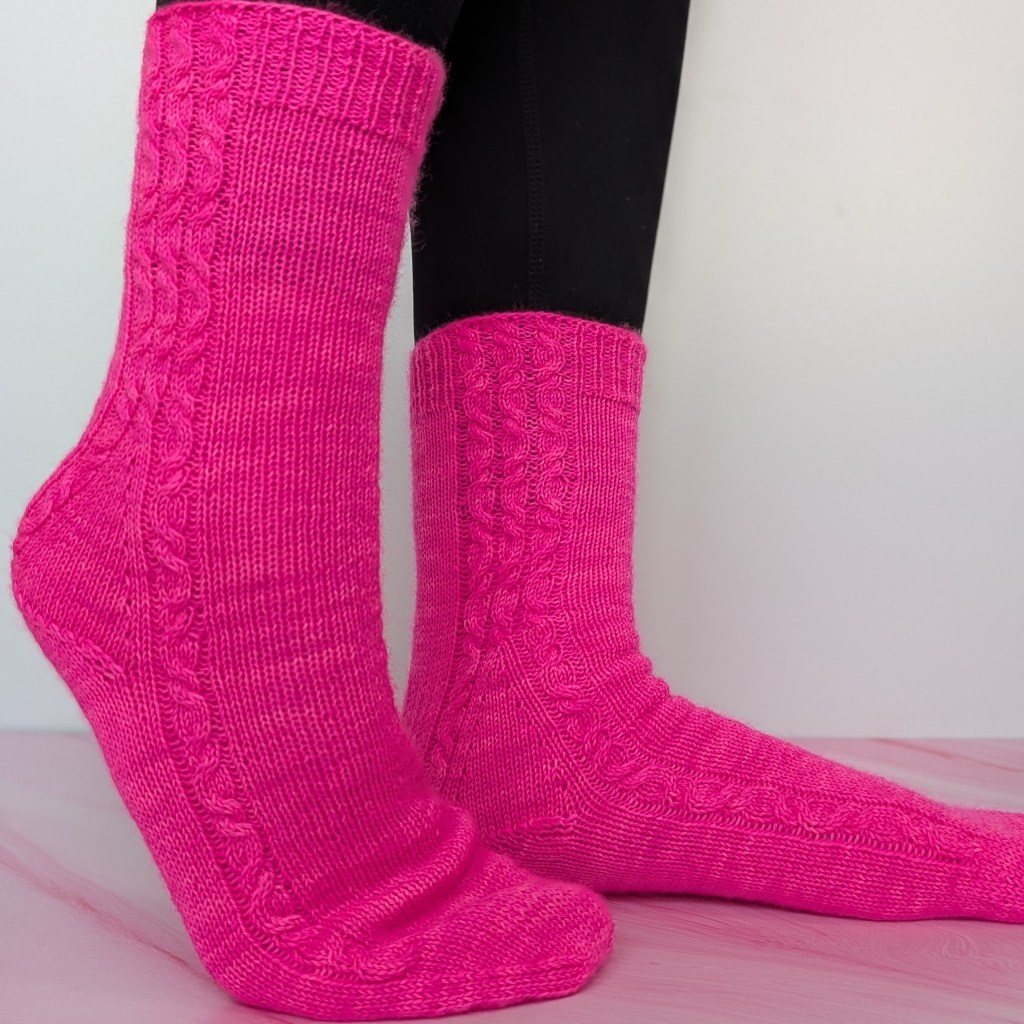
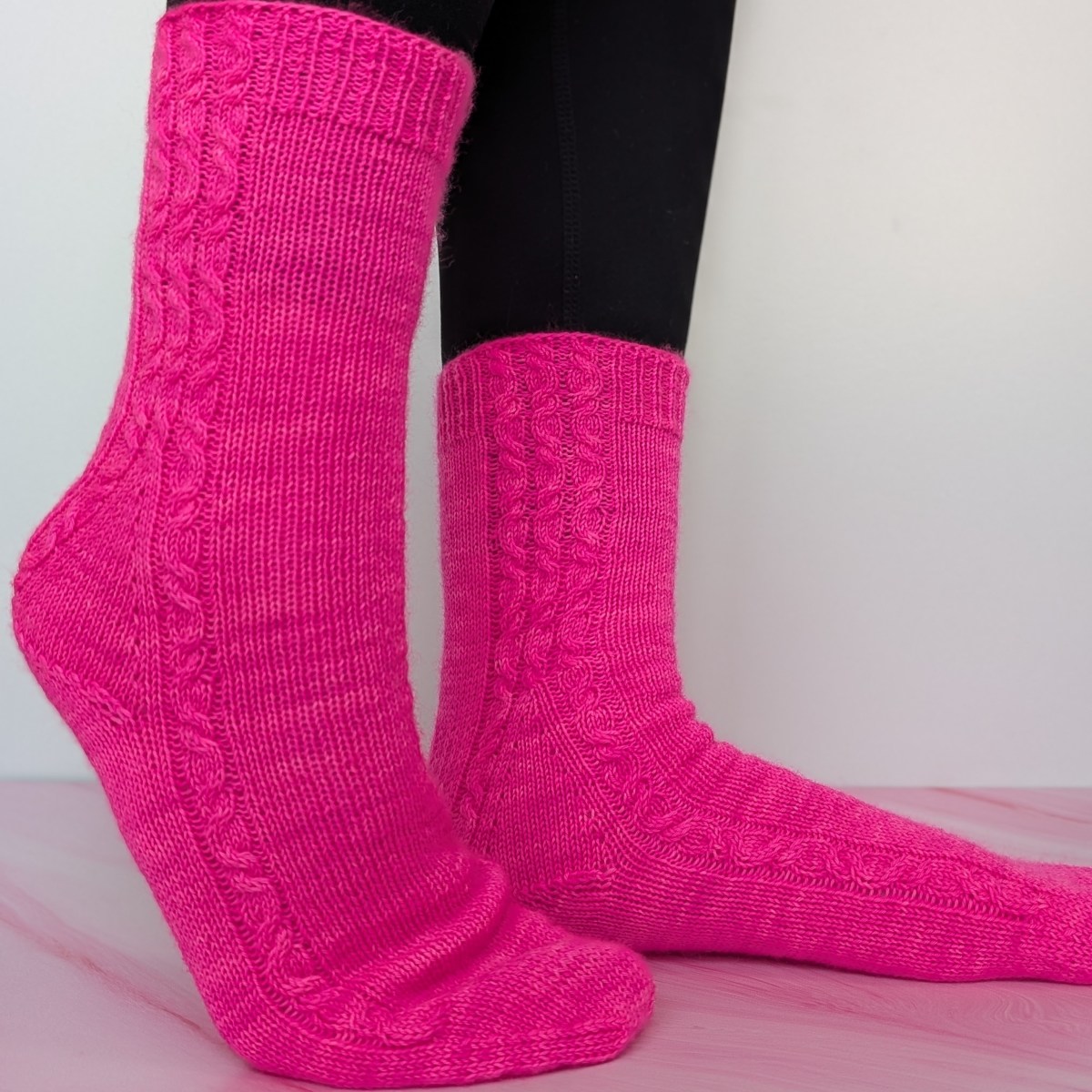
Today I am so excited to share that my newest pattern, the Wave Function Socks, has finally been published! When I took physical chemistry in college, quantum mechanics was one of my favorite topics. It was all math and functions and complex formulas, and my brain just loves a good problem. The wave function of a particle describes a few things, including the probability of a particle’s location being in a specific place. My friends and I liked to make jokes about how parts of our wave functions were vacationing on the beach — admittedly, this was a very low probability, but we thought we were funny and clever.
The Wave Function Socks presented a few good design challenges that I was keen to tackle. The first problem I tackled was determining the perfect formula for cable spacing so that the waves would be visible both on a sock blocker and when worn. After many swatches, I think I ended up with the perfect wave cables! For these socks, I really wanted to have the cable panels centered on the sides of the sock instead of on the instep, and for the cables to transition neatly to the foot and the heel. To accomplish this, I created a modified Strong Heel. This variation features slip-stitch reinforcement where your socks rub against the back of your shoe, and the symmetric increases on the side allow the cables to gracefully flare out over the ankle. Best of all, we have a look and fit similar to that of a heel flap and gusset, but with no picking up of stitches.

The Wave Function Socks feature an easily memorized pattern that will allow you to take them on the go or allow part of your mind to wander off on its own wave function beach vacation. Carefully placed increases and decreases mean that you don’t have to debate which size to knit — just cast on for your normal size!
The pattern will play nicely with any fingering weight merino/merino nylon blend yarn in solid, tonal, lightly speckled, gradient, or low-contrast colorways. The pattern has been tech edited and test knit and is all ready for you to cast on!
Thank you so much for subscribing to my newsletter! Please enjoy 50% off of the Wave Function Socks pattern now through August 8th with the code TECHNICOLORMOM.

I’m so excited to share my newest pattern, the Watering the Trees Beanie! This pattern was designed intentionally for gift and charity knitting and is my gift to you. You can snag your copy of the Watering the Trees Beanie Pattern here.

For the past couple of years, I have endeavored to knit hats for my growing number of nieces and nephews in lieu of toys. In 2024, I knit a dozen hats in December. Although I failed to capture a photo of all of them together, I did share a reel on Instagram. Not all of the designs that I used have been published yet, but I did manage to get one of them written up, tech edited, test knit, and finally published!

The Watering the Trees Beanie is the hat version of my Watering the Trees Socks pattern that I designed a couple of years ago. The idea came about after my then-six-year-old and two-year-old decided to “water” our backyard trees. The event mostly involved the two of them running around and spraying each other with the garden hose, but they had fun, and the two maple trees in our backyard did manage to get a bit of water. When the light caught the droplets of water just right, a little rainbow added joy to our backyard fun.
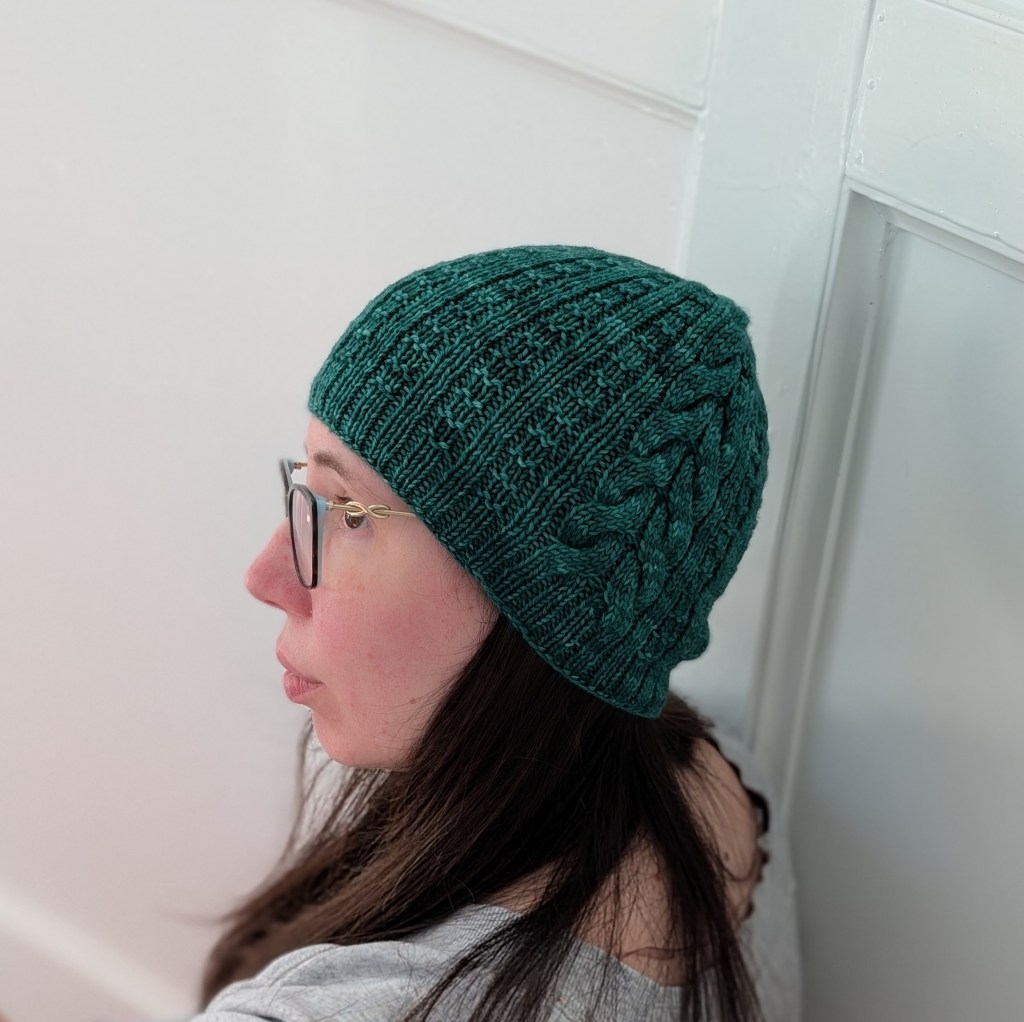
The design features two mirrored cables to represent our two maple trees, and the textured ribbing makes me think of the streams of water from the garden hose. The pattern features my signature use of increases and decreases to make the cables pop without bunching or gathering the fabric beyond the cables.
The Watering the Trees Beanie pattern includes sizes for the whole family, including baby, toddler, child, adult s/m, adult l, and adult xl sizes. It is designed to fit head circumferences from 14″ (36 cm) to 26″ (66 cm) comfortably. I prefer a generous fit in my hats, so I size my patterns with a looser fit in mind; you can size down for a snugger fit.
I have a 23″ circumference head and prefer the adult l size. You can see it here in purple.

I suspect that the most commonly knit size will end up being the adult s/m size, which I am modeling here in green.
Should you decide that you need some matching cozy socks, check out my Watering the Trees Socks pattern. These socks are cozy and cabled, and my use of increases and decreases for the cables makes choosing a sock size easy – just pick the cast on number closest to the one you use for your favorite vanilla socks. You’ll want to stick with a similar favorite yarn and needle size for socks.

This hat knits up rather quickly using DK weight yarn, and I love it for gifts for anyone. I hope you’ll join me in making a few of these hats for yourself, your friends and family, and for donations to individuals and organizations who may need some extra love in the coming seasons.
Do you have any preferred organizations that you knit for? Let me know here! I’m planning to send a few pieces up to Knit the Rainbow and already have a couple saved away for them.
Y’all! I designed another pair of socks! In 2019 years ago, I reached out on Ravelry to recruit test knitters for my third sock pattern, the Fireside Cable Socks. One of my volunteers, Jordan, knit a lovely pair of socks as she was testing out the pattern before publication. Fast forward to 2022, when I was able to regularly go to my local knitting group for Knit Night. I became fast friends with Jordan, who shares my love of pink, hand-dyed yarn, and all things cables. A long while later, we realized that these two Jordans were the same person! How small is the world that someone I interacted with online three years before ended up being at my Knit Night?!

Jordan is on the receiving end of a lot of my design-related brainstorming, and she is enthusiastic and encouraging as she reads and responds to all of my text messages. I’m so thankful that we had the chance to meet in person! We have spent a lot of time talking about socks and what would be our “perfect” sock design. Jordan really loves when patterns continue onto heel flaps, and we both really love cables.
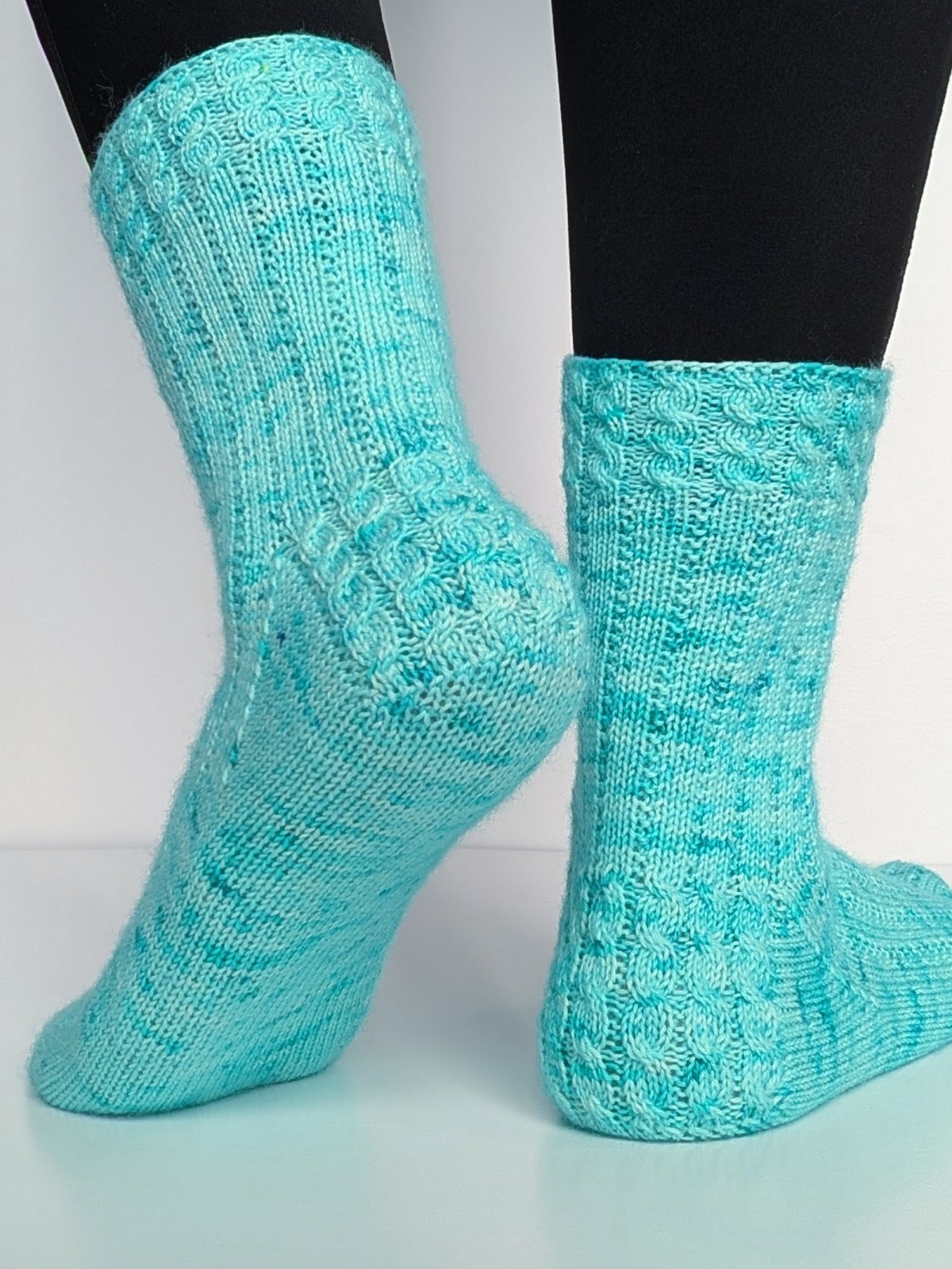
So, I promised her a design with a fancy heel flap. And here we are! The Alexander Socks, named for my friend Jordan, are for those of us Hamilton fans who will never be satisfied with vanilla socks and want to elevate our socks without a huge commitment to fixing missed cable crosses or having to focus, focus, focus. When incorporating these cables, I used what has become my signature increases and decreases at the starts and ends of the cables so that you don’t have to think too hard about which size to make — just use your vanilla stitch count, and you are good to go. I used Teal Torch Knits TTK Sock in the colorway Tall Drink of Water for my sample, and I love how these light speckles look with the cables.
The Alexander Socks are knit cuff down, beginning with a German Twisted Cast-On and a beautiful cabled cuff. The leg of the sock features a relaxing 3×1 broken rib that continues down the foot of the sock. A cabled heel flap levels up the socks, and a traditional gusset makes for a great overall fit. The broken rib texture flows into the rounded toe for a polished look with a comfortable fit. Kitchener stitch is used to finish off the sock.
I’ve now knit three pairs of these socks — two for myself and a tiny pair for my 4-year old. The great news is that this pattern includes five cast-on sizes: 48 sts, 56 sts, 64 sts, 72 sts, and 80 sts. The 48 sts size is great for little kids with fingering weight yarn, or if you knit them with DK weight yarn, you’ll get a super cozy pair of adult socks. I use the 56 sts size for my 8 year old, and I knit the 64 sts size for myself. I usually use 72 sts for my husband or dad, and the 80 sts size is great for anyone who struggles with foot swelling or needs a looser fit.

I knit these pink socks using Leading Men Fiber Arts Show Stopper in the Pink Lemonade colorway. How amazing is that tonal?! I already have another pair of these on the go for my daughter, and I’ve got several skeins of yarn that would look amazing with these cables. What colorways do you think will look fantastic in these socks? I think this pattern will play nicely with any fingering weight merino/merino nylon blend yarn in solid, tonal, lightly speckled, or low-contrast colorways. I’m thinking Lolabean Yarn Co’s The City So Nice, They Named It Twice colorway would look amazing in this design — I used that colorway for my Concentration Shawl design a couple of years ago.
Are there any design features that you would love to see in a pair of socks? I’m really enjoying the fancy cuffs and heel flaps and of course cables!

Until December of 2024, I had never knit a pair of DK weight socks. I’m usually a fingering weight sock person. I love wearing them, I love knitting them, and I especially love collecting fingering weight yarns.
In December, I saw a friend had knit a pair of socks by holding fingering weight yarn doubled (i.e. holding two strands together), and I thought I’d give it a try. So for my Christmas Eve cast-on, I started a pair of Super Sprinkle Socks by holding my fingering weight yarn doubled.
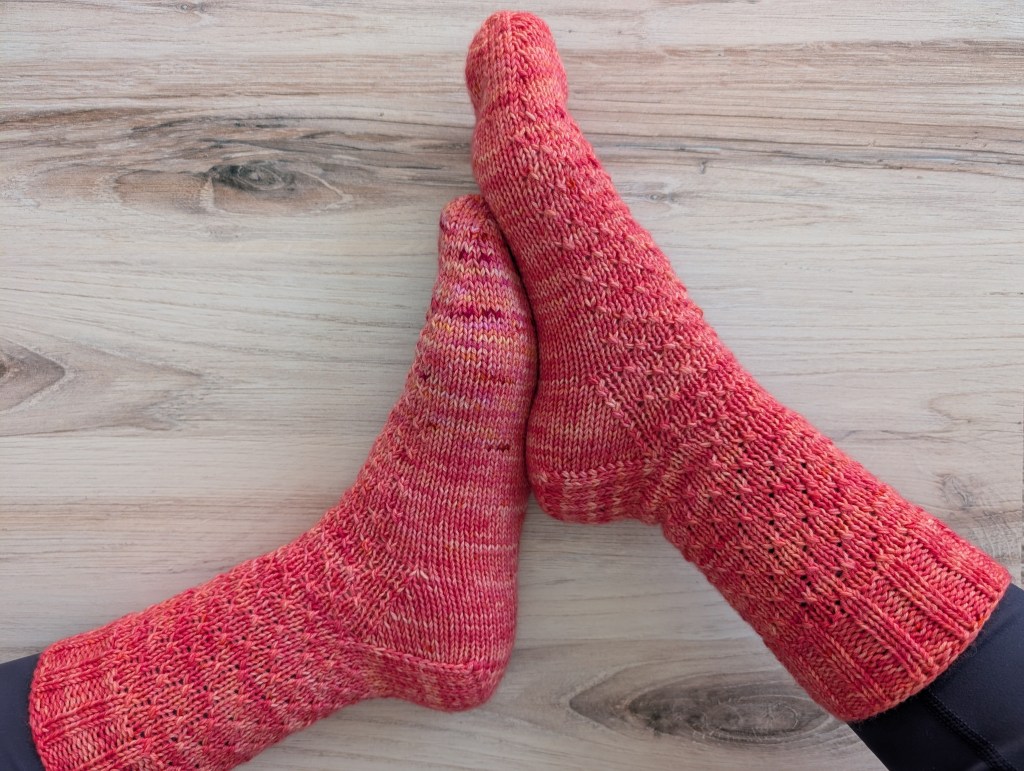
I LOVE how these turned out! It took me less than a week to knit these, and I’ve been wearing them every chance I get. They are so cozy and warm, and I think they’ll wear a little longer than my usual fingering weight socks. (I’m tough on my socks, it turns out. Luckily, I’m the only person in my family who wears through socks, and the good news is I can always knit more!)
For this project, I chose my Super Sprinkle Socks pattern. I published this design in November 2023, and I love how this super easy texture works with speckled and tonal yarn. I originally designed these socks with fingering weight yarn in mind, and I knit the originals at a gauge of 9 sts and 12 rounds per inch using a 2.25 mm needle. For this sock, I used a 3.25 mm needle and knit a smaller size at a gauge of 7 sts and 9 rounds per inch. I used Jems Luxe Fibers Luxe Sock in the colorway Sirens.

When I designed the pattern, I included five sizes: 48 stitches (sts), 56 sts, 64 sts, 72 sts, and 80 sts. Most adults will find that the 64 sts or 72 sts sizes fit best, but I love knitting socks for my children as well, and my youngest wears a sock with 48 stitches, so I like to include the size in my patterns when possible. I usually knit the 64 sts size for myself. At my fingering weight gauge, that gives me 64 stitches divided by 9 stitches per inch equals 7.1 inches circumference for my socks. I did a little math, and it turns out that if I knit the 48 sts size at a gauge of 7 stitches per inch, I’ll end up with roughly the same circumference sock: 48 sts/7 sts/inch = 6.9 inches.
I’m pretty adventurous as a knitter and have no problem restarting something if it doesn’t work out, so I cast these on using a 3.25 mm (US #3) needle, which gave me 7 stitches per inch. I love the resulting fit!
I did run into a little snag along the way, however. When you use thicker yarn to make socks, the yardage is going to change. I used 56 grams of yarn for the first sock, and my skein only had 49 grams left for the second sock. That was a problem. Fortunately, it turns out that I have a color type, and I was able to find some leftover yarn from another project that matched up pretty well. The crochet granny square in the photo below shows some of the yarn I used: Suburban Stitcher’s Naranjita colorway on her sock base.
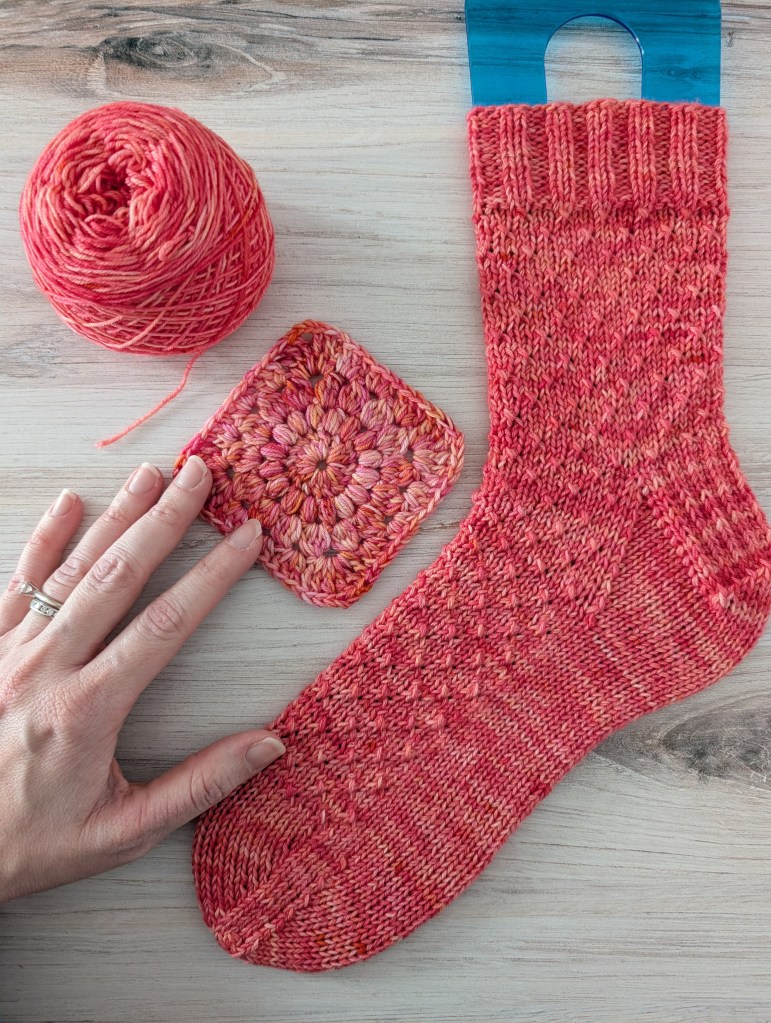
The color wasn’t a perfect match, but it was close enough that when I held it together with the yarn that I was using, it blended in pretty well. I was able to finish up the socks! Yay!

You can see a little bit of the color difference in the toe of the left sock (shown above), but I think it worked out pretty well! The slight color difference certainly won’t stop me from wearing them as much as possible.
These socks were such a quick knit and great fit that I made a second pair in January!

For this pair, I prepared to run out of yarn and used a contrast color for the start of the cuff and the toe of the socks. This yarn was Hue Loco’s Phyllis Sock base in the colorways Petunia (gray) and Oh Snap (green). I am so happy with how these turned out, and I know that there will be many more pairs of DK weight socks in my future. I started these on January 18, 2025 and finished them up on January 26, 2025.
I love how fun this texture is for these socks, but I’m definitely eyeballing some of my other patterns that include a 48 sts size for a future pair of DK weight socks. The Dragon Fairy Socks are also a contender, and I think the Candy Dot Grid Socks and Pause Time Socks would be fun in a thicker sock as well.
What do you think? Have you tried knitting a pair of DK weight socks? What patterns have you resized to get a fit that you love?

See what I did there?
I am so excited to share my newest design, the Pause Time Hat. This hat pattern is so special to me for several reasons. As I was designing this hat last year, the temperatures had just dropped where we live in Georgia. I can’t be a proper knitter if my family doesn’t even have hats, so I needed to get this one knit up as soon as possible. After the prototype was all blocked and dried, I tried it on my then three-year-old son to snap a few pictures and make sure I liked the crown, and he immediately walked over to my husband to show off his new hat. “Hey, Dad! Look at my new hat,” he said. “Mom made it for me!” This interaction just about melted my heart, and I wished I could pause time and hold onto that moment forever.
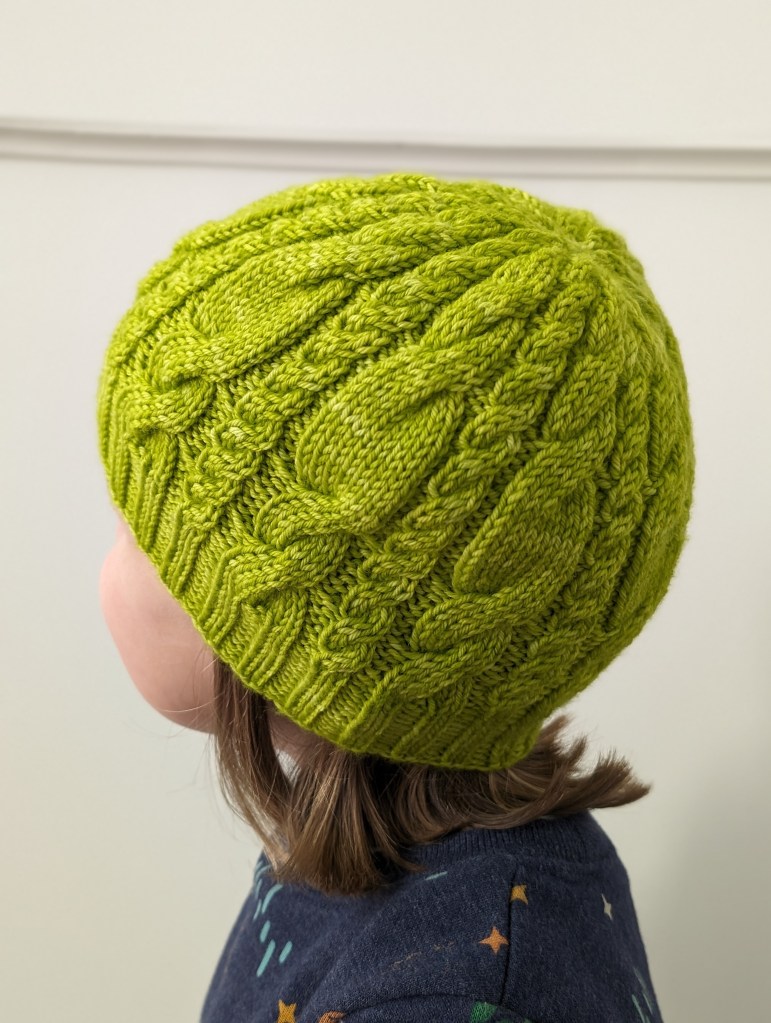
I made few adjustments to the hat as I wrote up the pattern, including an adjustment to needle size and the crown decreases, and I am so happy with how it turned out. The Pause Time Hat is the hat version of my sock pattern, Pause Time Socks. Earlier this year, I shared the socks and how I had just finished knitting a pair of these for my MawMaw. My MawMaw was so excited for the socks, and I shared daily updates with her as I was knitting them. I am sad to report that the socks that I knit for her have yet to be worn, as she passed away unexpectedly a couple of days after I finished knitting them.
I wasn’t ready to lose her, and I wish time had paused for just a moment longer so that we could have kept her here with us. I still miss her every day, and there are so many moments throughout the day where I see her impact on me and my family. When I read books to my son at night, I see her inscriptions in the front of the books saying how much she loves us and is proud of us, and I hope that I leave these kind of reminders for my own children as they are growing up.
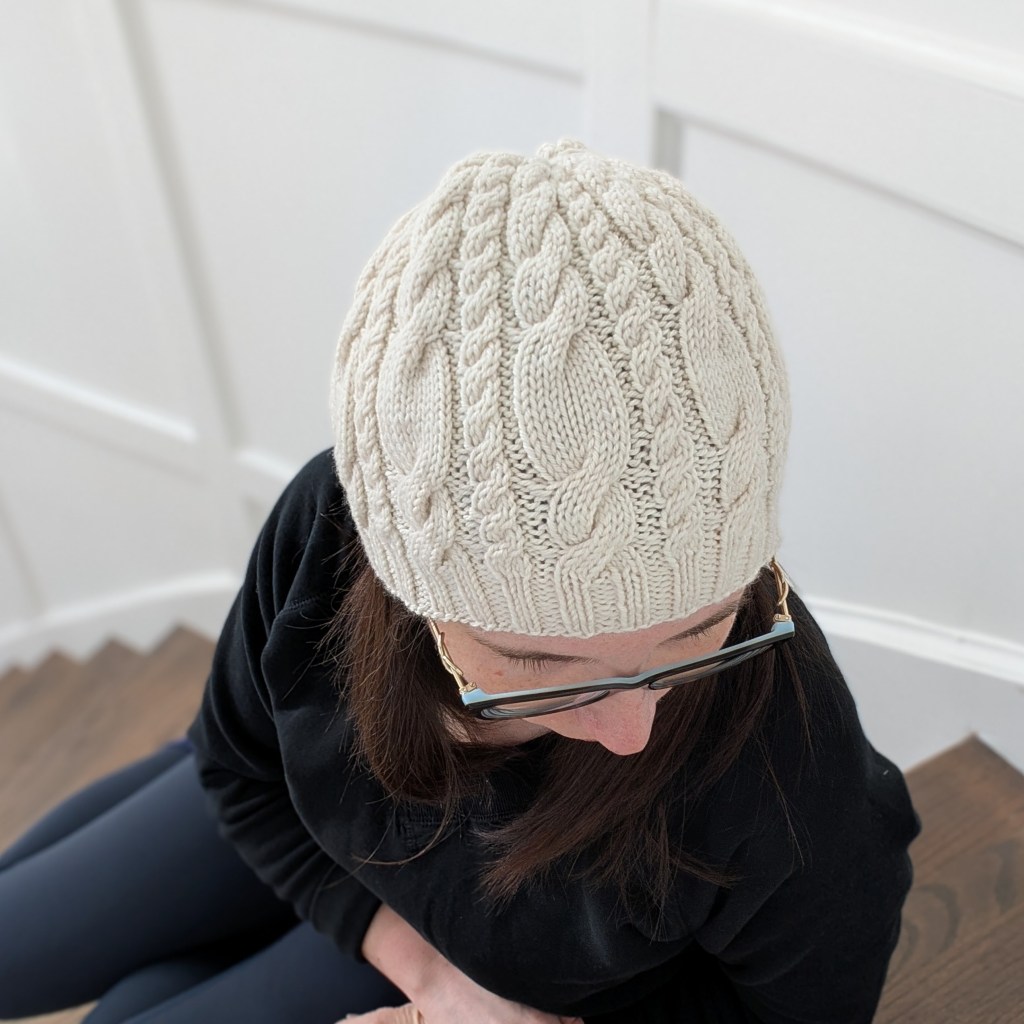
The Pause Time Hat is a capsule for those special moments, and the break in the large cable is there to remind us to take that moment to breathe and remember. There were a few iterations of the hat before I got it just how I wanted it, and I know my MawMaw would be proud of the perseverance and problem solving that went into getting it right.
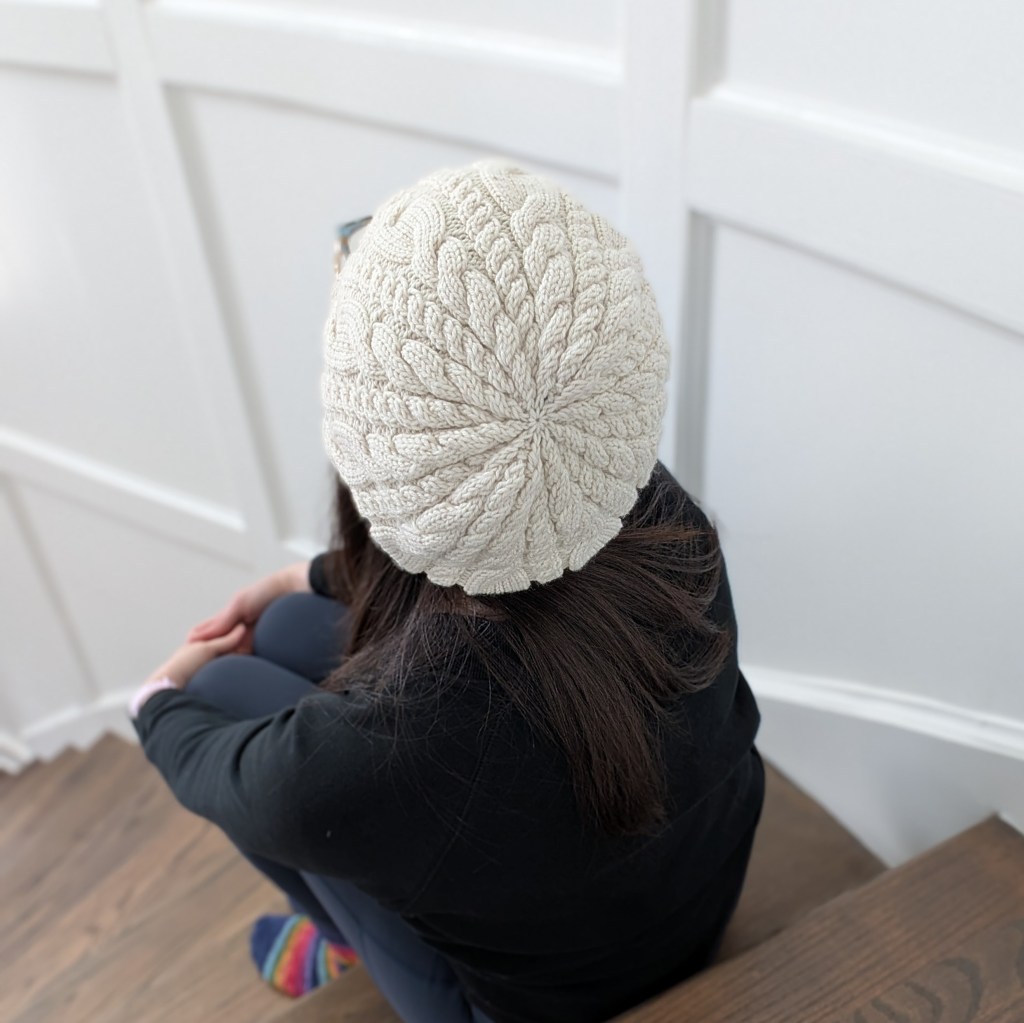
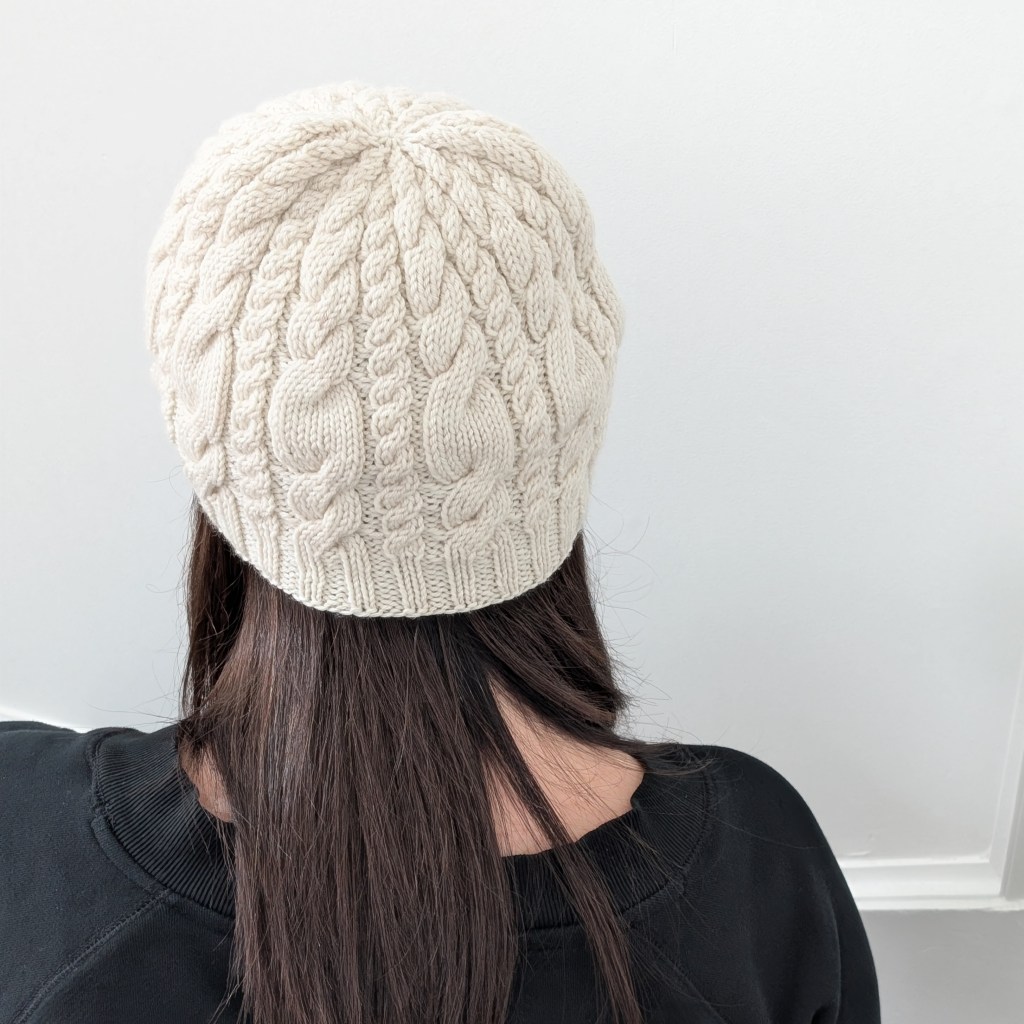
The Pause Time Hat is knit from the bottom to the top, beginning with a German Twisted Cast-On and 2×2 rib. Carefully placed increases transition the ribbing to tightly twisted cables without bunching, and the cables are continued into the crown decreases. This pattern will play nicely with any DK weight merino/merino nylon blend yarn in solid, tonal, or lightly speckled colorways. The hat is sized for the whole family and ranges from Baby to Adult Large. Photos show the Adult L on a 23″ head circumference. The pattern has been professionally tech-edited and test knit.
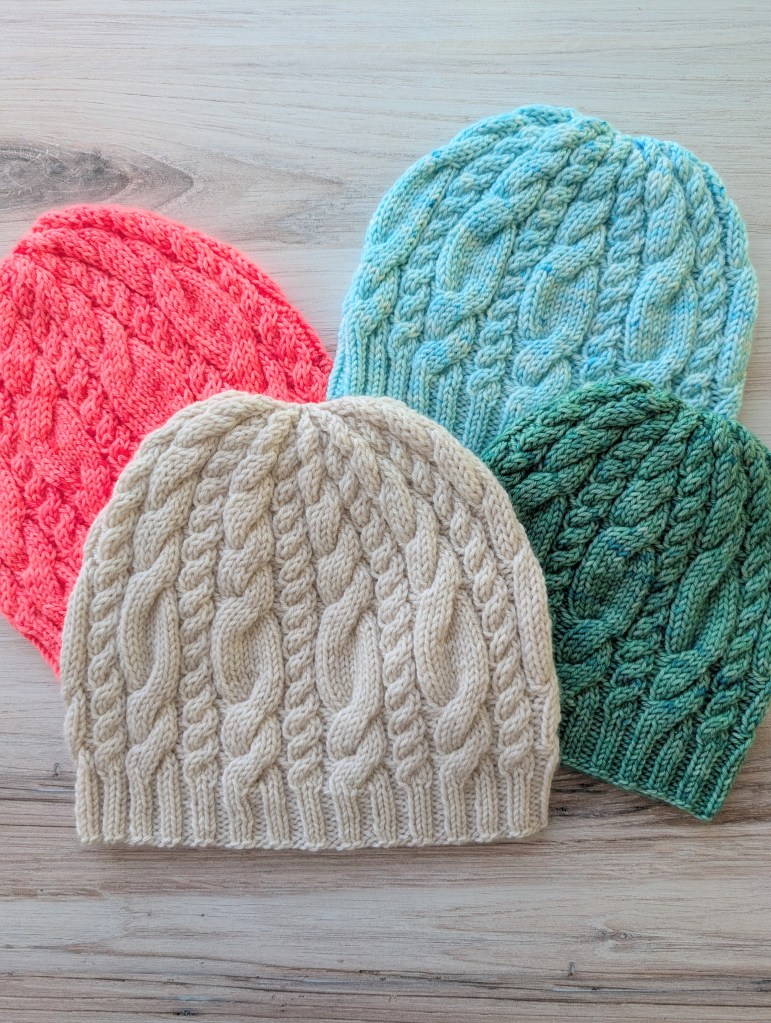
I have knit this hat up in several colorways by this point, including the lovely Neon Melon colorway from Teal Torch Knits that matches the original sock pattern. The Neon Melon was intended for me, but alas, it ended up being just a bit tighter than I like for my hats to fit, so into the gift pile it goes!
The pattern can be found over on Ravelry, and it’s 20% off from now until Wednesday, December 11, 2024 with the code PAUSETIME20.
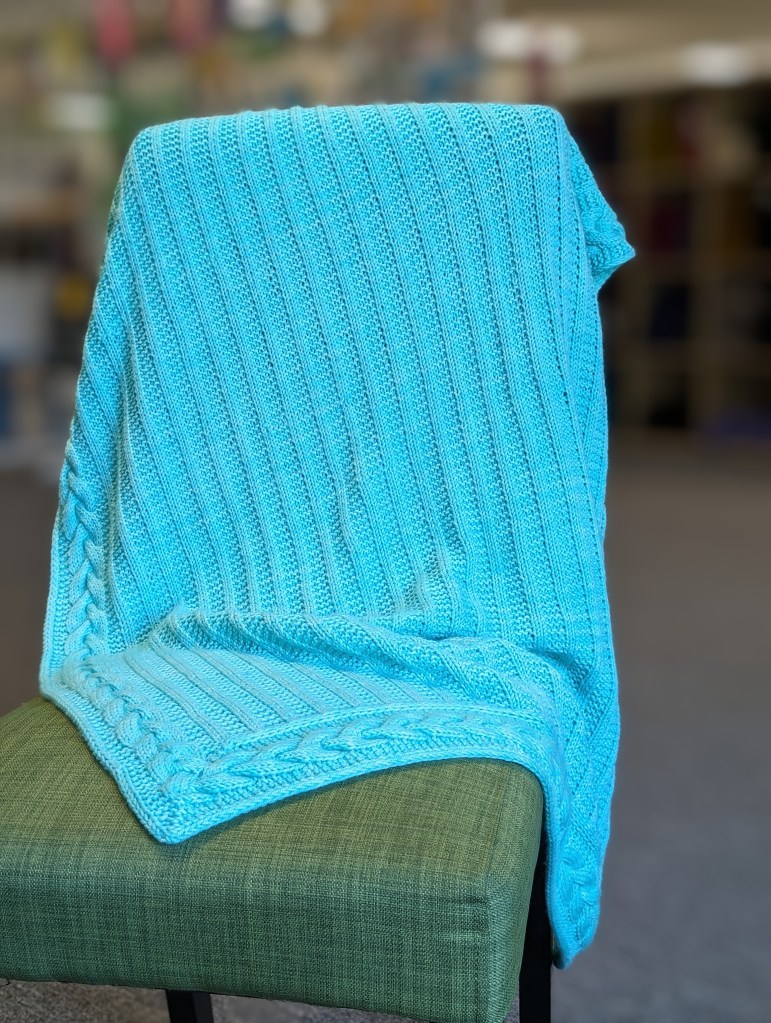
After publishing my Dilution Cowl pattern, I kept thinking about how lovely the cables and texture looked and how nice they would look together in a blanket design. I daydreamed about the corners on this blanket for months before I finally picked up some needles and yarn and started swatching. I love a challenge, and I knew I wanted the cables on this blanket to stun at the corners. The way the cables met at the corners had to be different from my Dilution Cowl and Concentration Shawl patterns because the cables needed to be continuous — they needed to go in the same direction all the way around the blanket instead of pointing towards one another at the corner. It took five or six tries, but eventually I figured it out.
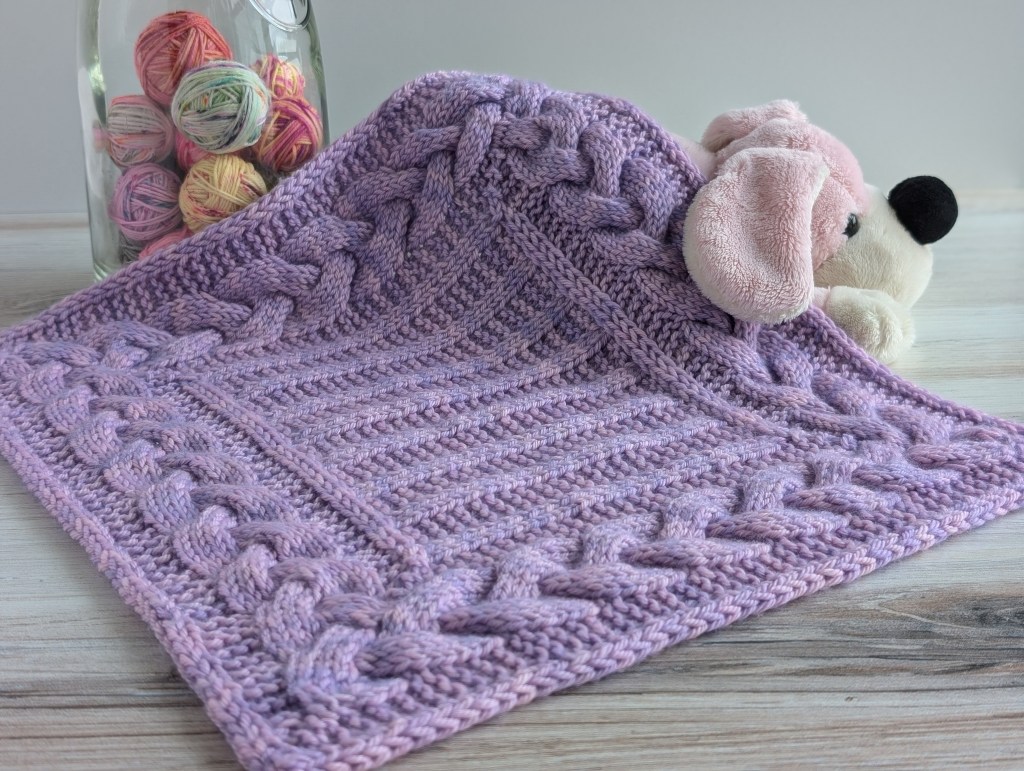
I started out by calculating what the smallest size blanket I could make would be in order to get in a full repeat and make the cables continuous. This purple version was knit using a skein of Hedgehog Merino DK in the colorway Hush. While I ended up using a worsted weight yarn for the pattern, I was able to make sure that my corners worked.
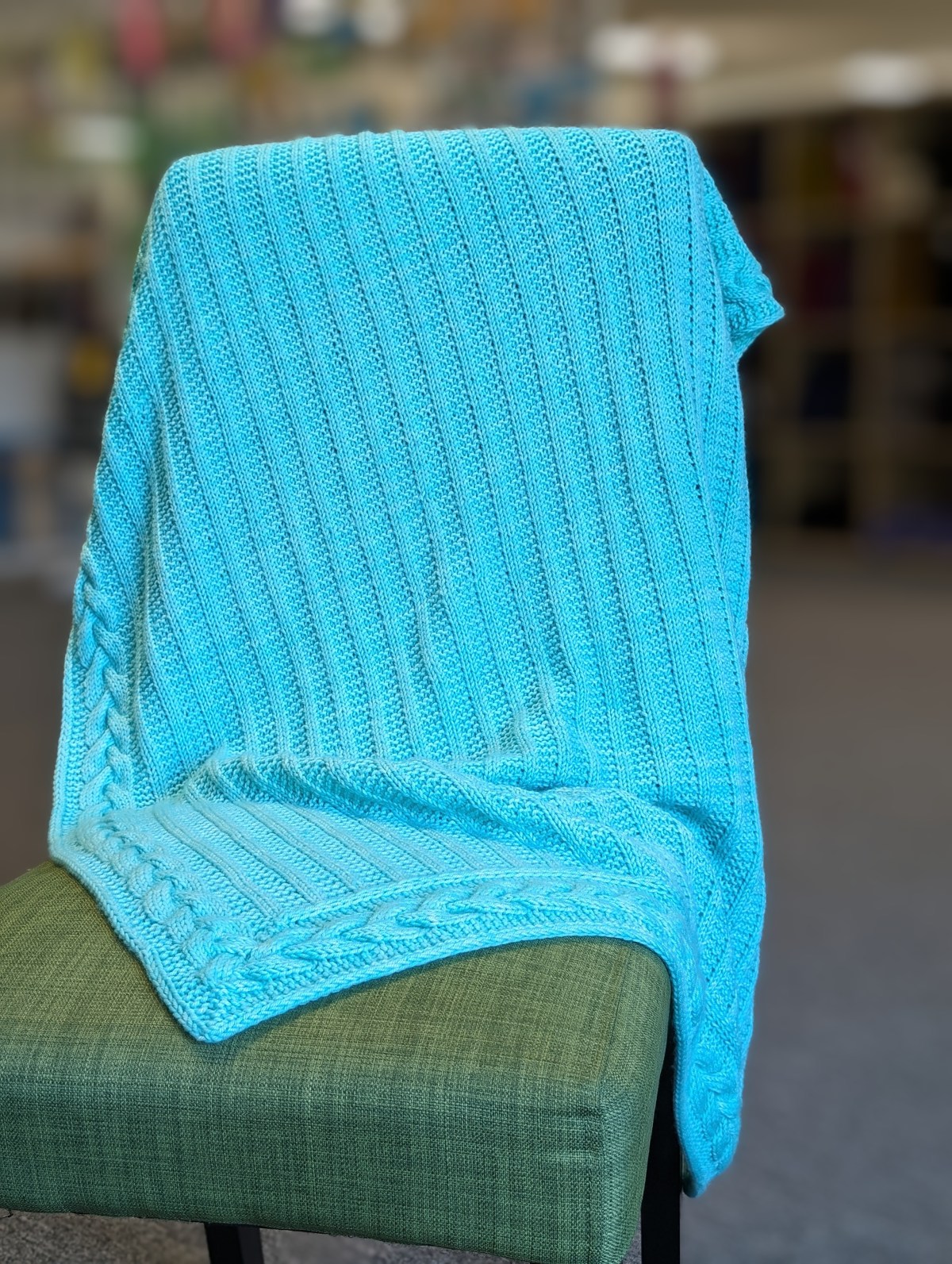
After all of the calculations and pattern drafts, I knitted up this lovely turquoise blanket in a size big enough to cover up with. I am so happy with it, and I can’t wait to gift it to my new nephew. I called the pattern the “Saturation Blanket” in keeping with my chemistry theme for this cable and texture combination that I’ve used in previous designs. In chemistry, a saturated solution is one in which the maximum amount of solute has been dissolved in a solvent at a given temperature. If you’ve ever ordered iced tea and really wanted sweet tea, you likely found that after dumping in a few packets of sugar, quite a few crystals of sugar settled on the bottom of your glass. This is because the solution, your now only slightly sweetened tea, is saturated; that is, no more sugar can dissolve in the iced tea.
While working on this blanket for my sister’s new baby, I kept thinking about how this child will enter the world with their parents’ and sisters’ hearts full of love, or, if you will, saturated with love.
The faux rib/garter texture of the Saturation Blanket creates a squishy, cozy fabric. The edges of the blanket feature beautiful braided cables that entwine at the corners and continue along all four sides of the blanket, giving it an elegant, cohesive look. With plenty of rest rows and pattern interest, this blanket will fly off the needles.
The work on the pattern didn’t stop after I’d finished making my full-size sample. I really wanted knitters to be able to complete the project without getting stuck, so I knit another sample and photographed my progress to guide knitters through the applied edging that is used to connect the cables along the top and bottom of the blanket.

I filmed a series of short video tutorials to help with any techniques that might be new to knitters, such as the Dec-9-to-1-k that helps make those beautiful cables connect to one another. And finally, I had the pattern tech-edited by a professional editor and test-knit by my lovely volunteers Cindy, Cyn, and Wilma.
This pattern can now be found on Ravelry, and if you use the code SATURATION20, you can save 20% from now until October 25, 2024. I can’t wait to see your beautiful new heirloom being gifted to yourself or your knitworthy loved ones.
Over the last month or so, my Instagram ads have been filled with cross stitch, modern embroidery, and punch needle kits and patterns. I clicked through a few of them and found a few that I really liked the look of, but I hesitated because do I really need a new hobby? Do I really want to order something from IG when I’ve had a bad experience in the past? While the answer is probably “no,” when I took my little one to the library for storytime and encountered a display about how March is crafting month, I decided to take that as a sign for “yes.”
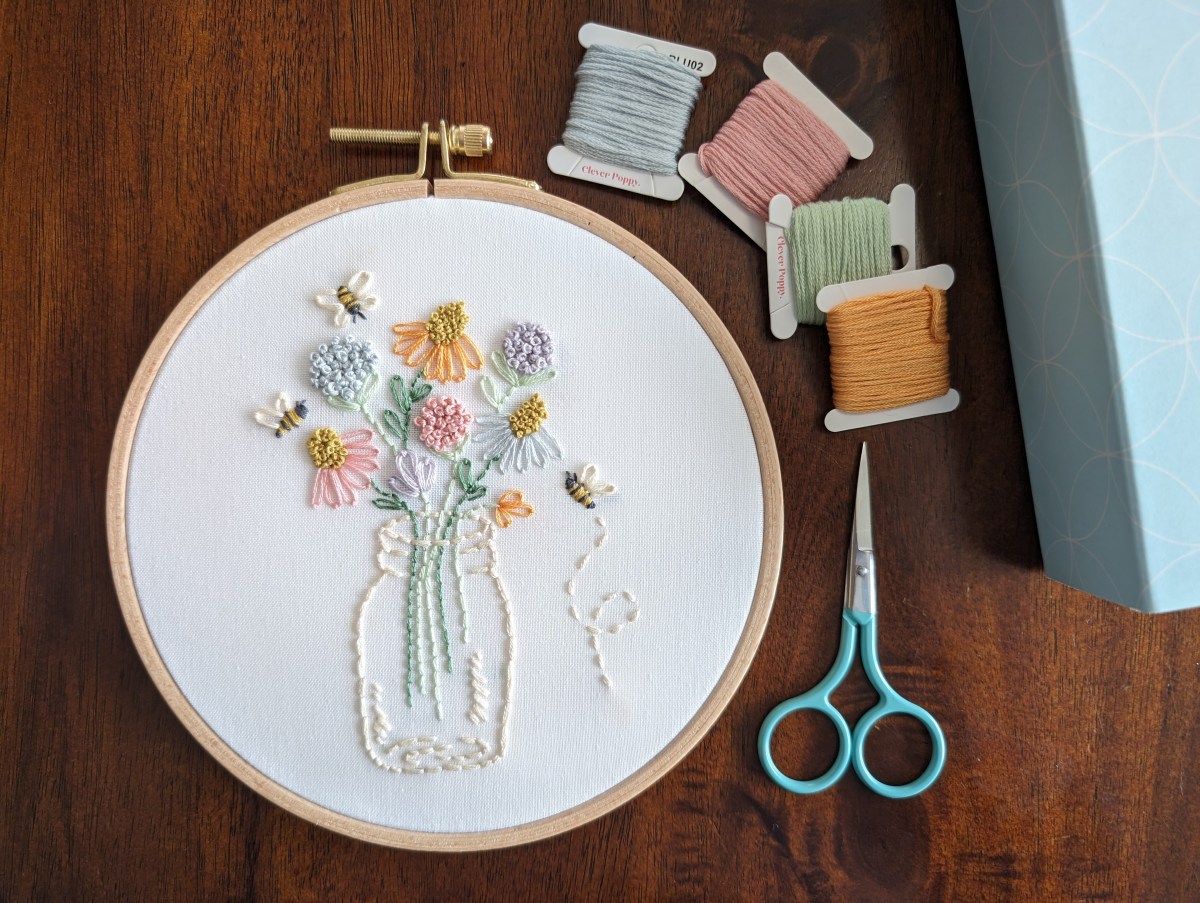
I picked one of the kits that I liked the best, and I put in an order. What happened after that? Well, Amanda has fallen down the rabbit hole. My first order (there have been…a few) was for beginner kits of “Bee Happy” and “Flora the Cat” from Clever Poppy. Y’all, I cannot even overstate how incredible my beginner experience has been with modern embroidery. My Clever Poppy kit, which was packaged beautifully, included a code to download the pattern and view tutorial videos on their website.
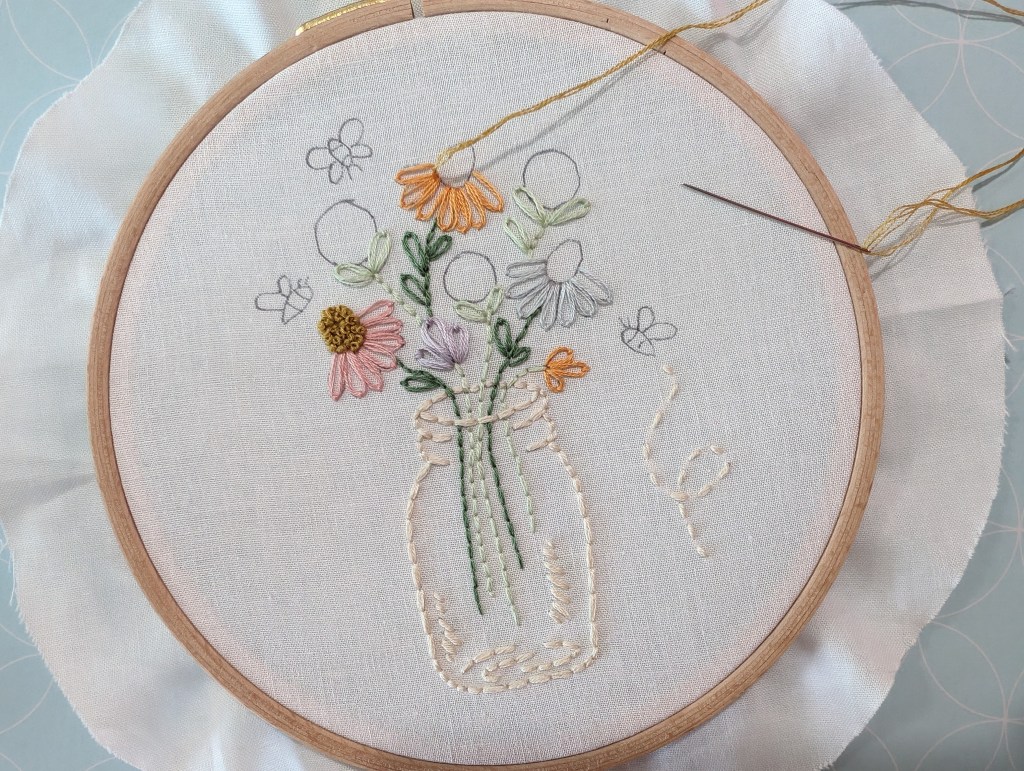
The user interface for the tutorials is fantastic, and Julie walked me through everything from dressing my hoop and tracing my pattern to making French Knots and Lazy Daisies, with check ins after each step of the way. I did not need to look up any information to complete the piece. The tutorial videos are so good, and each one is only a few minutes. Julie included tips and common things that newbies do compared to experienced embroiderers. She maintained an energetic, positive, and encouraging vibe throughout the experience.
I made “Bee Happy” first, and I am so happy with how it turned out. It is currently living on my wall in my bedroom, and I am well on my way to filling my home with handmade art. (We already have tons of knitted gnomes.) This was my very first attempt at learning embroidery.
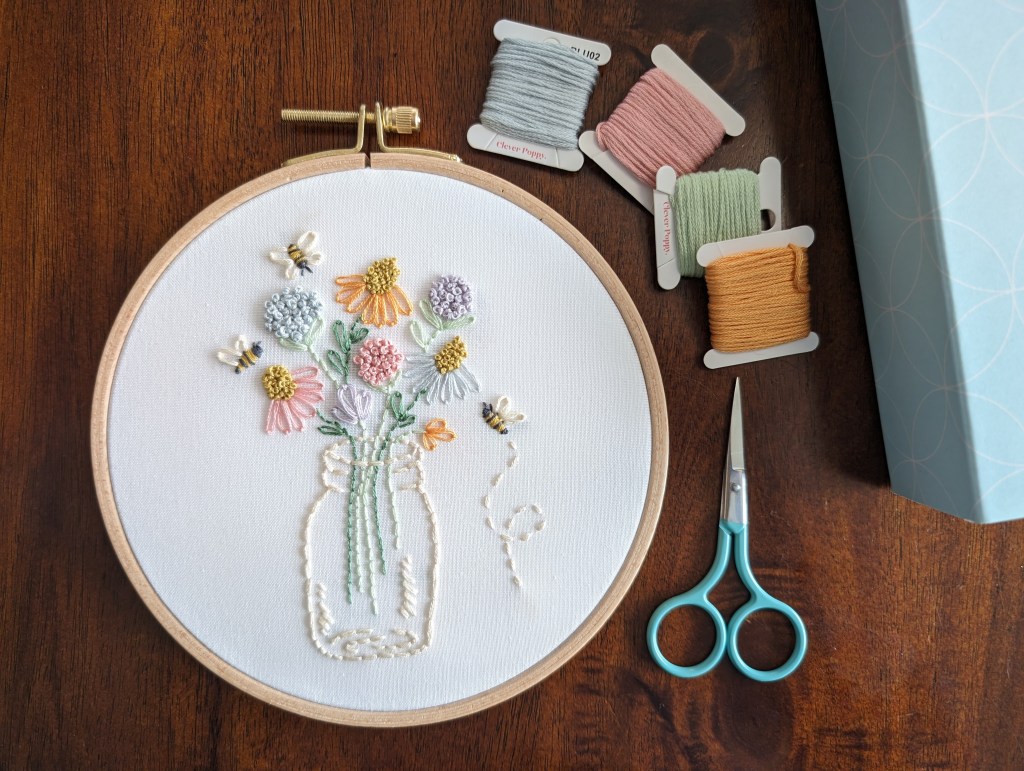
I started “Bee Happy” on March 13, 2024 and finished it on March 15, 2024. I did not make any modifications to the pattern. One of the things I am loving about my embroidery experience is how quickly you can see progress in your project. With knitting, sometimes I can work on a project for hours and only see minimal progress. Embroidery keeps my mind from wandering because I need to pay attention to each stitch, whereas with my knitting, I can almost do it in my sleep, and sometimes my mind is all over the place.
Do I recommend one of these kits from Clever Poppy for people who are interested in learning modern embroidery? Before I give you my answer, here are the caveats: (1) this is not a sponsored review in any way; I do not benefit from you purchasing from them in any way other than getting to potentially chat with you about our new hobby, (2) I did not try out kits from other brands, and (3) while I had never tried embroidery before, I would consider myself an experienced crafter (knitting, crochet, quilting) and did not encounter any challenges or difficulties. The few emails I have exchanged with the Clever Poppy team since I began learning embroidery have been answered quickly and effectively.
So, do I recommend it? Absolutely yes. The price point ($50) is comparable to what I would pay for a skein of yarn ($30), pattern ($5), and set of knitting needles ($15), and the tutorial and interface is fantastic. Plus, they have a beautiful website.
After I finished up my “Bee Happy” kit, I immediately started on “Flora the Cat.” My daughter loves cats, but we cannot have one due to allergies, so I thought she would enjoy this piece. I am planning to include it in her Easter basket to hang in her bedroom.

I started this project on March 16, 2024 and finished it on March 21, 2024. I did not make any modifications to the pattern. I loved making the woven roses, and I think the cranberry-colored French Knots are the most beautiful touch. I also loved learning Satin Stitch and Julie’s method for tapering your stitches to make gorgeous petals. I love how she turned out!
Have I convinced you to try out embroidery? Of course, I do not want to push you in a direction you weren’t already going, but if this is something you’re interested in, I want to encourage you to give it a try! Have you already learned embroidery? What kinds of projects and patterns do you love making? What is your favorite piece?

I think it would be accurate to state that I am obsessed with my latest sock pattern. Last week, I published the Dragon Fairy Socks pattern, and I love, love, love knitting these socks. This design features a textured panel on the front of the sock, and the back of the sock is stockinette. When I say these fly off the needles, I am not kidding. I gave a sneak peak of the sock a few weeks ago when I shared the socks I made for my grandmother. I gifted them to my grandmother for her birthday, and she loved them!
The difficulty rating for the Dragon Fairy Socks pattern is EASY. This project is worked in the round from the cuff down and includes an easy textured stitch and decreases. Kitchener stitch is used to finish off the toe.

The pattern has been tech edited and test knit.
On the way home from school one winter afternoon, as I was finishing up the second sock for this sample, my daughter was arguing that she didn’t feel cold outside because she is a “Fire Fairy.” My 3-yo piped up and declared that he is a “Dragon Fairy,” and I thought the conversation was just the cutest thing. I was struck by how the texture on the front of these socks resembles dragon scales and how the knitted bars highlight individual colors in the fabric like the sun glinting off of iridescent fairy wings. Thus, I decided to call these socks the “Dragon Fairy Socks.” The texture on these socks makes the pattern ideal for any yarn dyeing style, from solid to variegated and anything in between.
This pattern will play nicely with any fingering weight merino/merino nylon blend yarn in solid, tonal, speckled, or variegated colorways.
I used Sock by Teal Torch Knits, a 75% superwash merino wool/25% nylon, 463 yds (423 m) per 3.5 oz (100 g) base. I used Christina’s Cake by the Ocean colorway for my blue/green sample. I love how the texture stitch shows off the variations in this color, and I am loving seeing this texture in yarns that I collected long ago but wasn’t quite sure what to do with.

Below you can see the pattern in Sweet Sock by Twisted Ambitions; I used Russ’s Sweet Like Candy colorway for these beauties, and I love how they turned out. I started these on February 5, 2024 and finished them on February 12, 2024. I always knit the 64 sts size for myself.


It was a little tricky to get the lighting correct for these socks, but the color is probably closest to the cooler photo on the right.
My children are so incredibly knit worthy, and for Valentine’s Day this year, I made them each a pair of Dragon Fairy Socks using Sequoia Sock by Treehouse Knits. I collected Lauren’s Land of the Living colorway a couple of years ago. I love how well this design shows off the intricacies of this colorway.

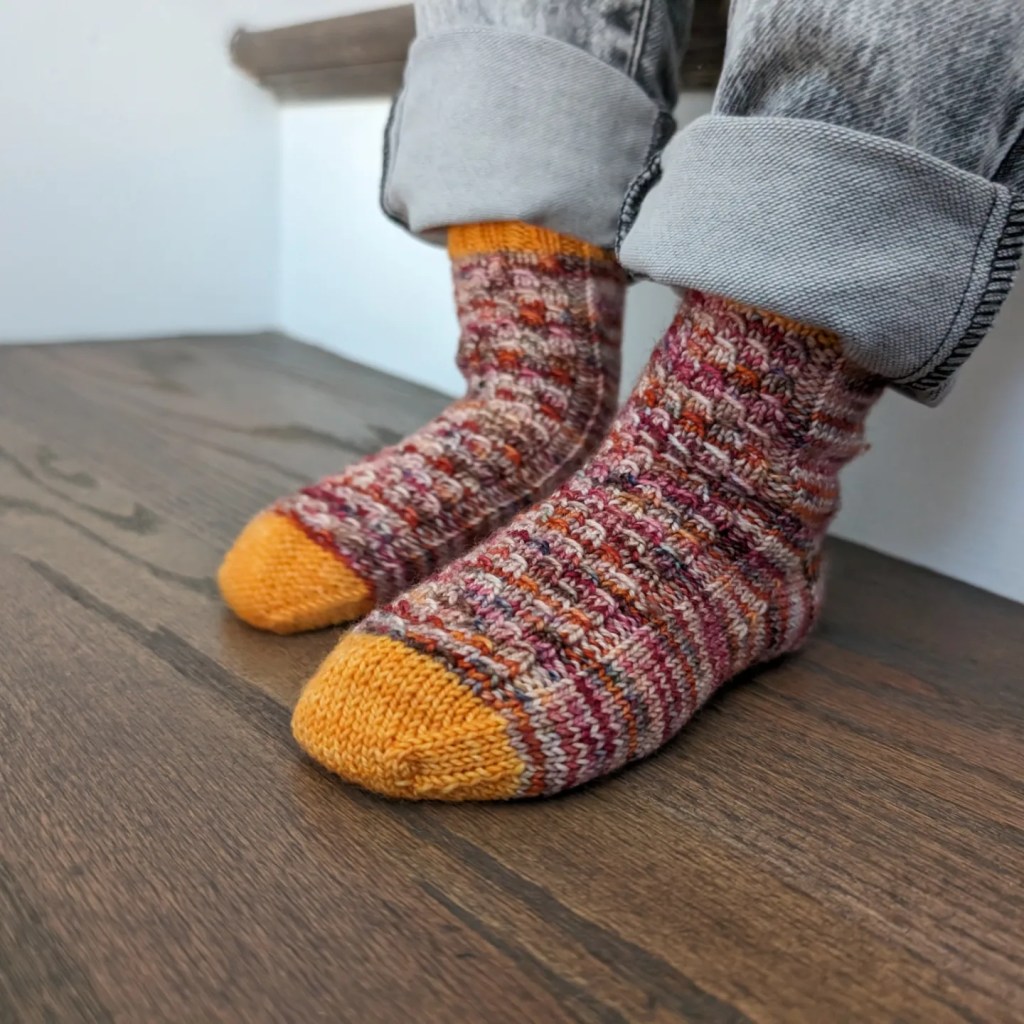
This sock set came with two minis, and I used them to add a pop of color at the cuff and a contrast cuff and toe. I used the 56 sts size for my 7 year old’s pair, which I started on January 17, 2024 and finished on January 22, 2024. For my 3.5 year old child, I used the 48 sts size and started them on January 22, 2024 and finished on January 25, 2024.
I have since started three additional pairs of these socks — two for my 7 year old and one for my husband, and I can’t wait to share them when they are finished.
Do you have any collected yarn that has been hiding away, unsure of what it wants to become? What yarn would you use for these socks?

I am so excited to share that the Pause Time Socks pattern is officially out in the world! This pattern is available on Ravelry, and the code PAUSE20 will get you 20% off now until Tuesday, February 6, 2024.
The Pause Time Socks are knit cuff-down, beginning with a German Twisted Cast-On and 2×2 rib. The leg and foot of the sock feature a beautiful trio of short and long cables on the front of the sock and stockinette on the back. A traditional heel flap and gusset make for a great overall fit, and a rounded toe and Kitchener stitch finish off the sock.
The difficulty rating for the Pause Time Socks pattern is INTERMEDIATE. This project is worked in the round from the cuff down and includes cables, slipped stitches, increases, and decreases. Kitchener stitch is used to finish off the toe.
The pattern has been tech edited and test knit.

It seems as though the older I get, the faster time goes, and sometimes I wish I had the ability to pause time. My two children seem to change and grow as quickly as the smaller cables on the Pause Time Socks. As I typed up this pattern, my three-year-old sat in my lap, pretending to type and control my finger movements. He won’t be small enough to sit in my lap for long, but I will enjoy the moment for now. The larger central cable takes the shape of an hourglass with longer stretches of stockinette between the cables, reminding us to pause and breathe in the beautiful moments around us.

This pattern will play nicely with any fingering weight merino/merino nylon blend yarn in solid, tonal, or lightly speckled colorways.
I used Sock by Teal Torch Knits, a 75% superwash merino wool/25% nylon, 463 yds (423 m) per 3.5 oz (100 g) base, in the Neon Melon colorway for my sample. I love how these cables pop in this color, and I cannot wait to get these cables onto some more accessories.
One of my goals for this year is to knit using stash yarn, and another is to knit gift socks for my extended family members. My husband, dad, mom, Grandma, MawMaw (maternal grandmother), and mother-in-law have all been enthusiastic supporters of my knitting endeavors, and this year I want to treat them to some handmade socks.
I wrote about the Dragon Fairy Socks that I gifted my Grandma a few weeks ago, and I just finished up a pair of Pause Time Socks for my MawMaw. She wears a size 6 shoe, so I was able to finish these up in just a few days. I love how these cables look in this gorgeous tonal yarn.

For these beauties, I used The Lemonade Shop House Sock in Sangria, which I purchased in September 2020. My MawMaw loves bold, saturated colors, so I thought this colorway would be perfect for her. I started these socks on January 26, 2024, and I finished them on February 2, 2024. You can find more info about this pair, including when I started the toe of the sock, on my project page on Ravelry. I’ve already started working on the sunburst granny squares to use up the leftover yarn.
Do you have a beautiful tonal or solid skein that would look amazing in these cables languishing in your stash? Maybe it’s time to cast on! Have you knit cables before? If not, what is holding you back? I’d love to ease any fears you might have about cable knitting.
